.jpg)
Between the Moche, Chicama and Lambayeque valleys lies one of Peru’s richest archaeological coastal landscapes. River water enabled farming across an otherwise dry strip; successive societies built adobe temples, palaces, canals and burial complexes. Trujillo and Chiclayo are the two practical bases, with fishing coast and agricultural towns between them. Distances look modest on a map, but each complex contains enough material for a focused visit.
‘Moche Route’ is a travel name, not a claim that everything along it is Moche. Huaca de la Luna, El Brujo and Sipán reveal different aspects of the Moche world. Chan Chan was capital of the later Chimú kingdom. Túcume contains principally Lambayeque, Chimú, Inca and colonial layers. That succession is precisely what makes the north coast compelling: it shows how power and landscape were repeatedly reorganised over centuries.
Trujillo: two earthen worlds on opposite sides of the city
Huacas de Moche: temple, mountain and painted walls
South of Trujillo, Huaca del Sol and Huaca de la Luna stand below Cerro Blanco. The current visitor circuit centres on Huaca de la Luna and Museo Santiago Uceda Castillo. Painted reliefs and successive construction layers reveal how ceremonial spaces were renewed and covered. The much larger Huaca del Sol dominates the landscape, but the complex’s plural name does not mean that both huacas are open visitor spaces.
Official visitor information starts ticket sales at the museum. That also makes interpretive sense: objects and models provide context before or after the reliefs. Check current opening and circuit order with the site manager. Give this place its own half-day; adding Chan Chan immediately afterwards means changing not only location, but culture, urban model and scale.
Chan Chan: a Chimú capital, not a Moche temple
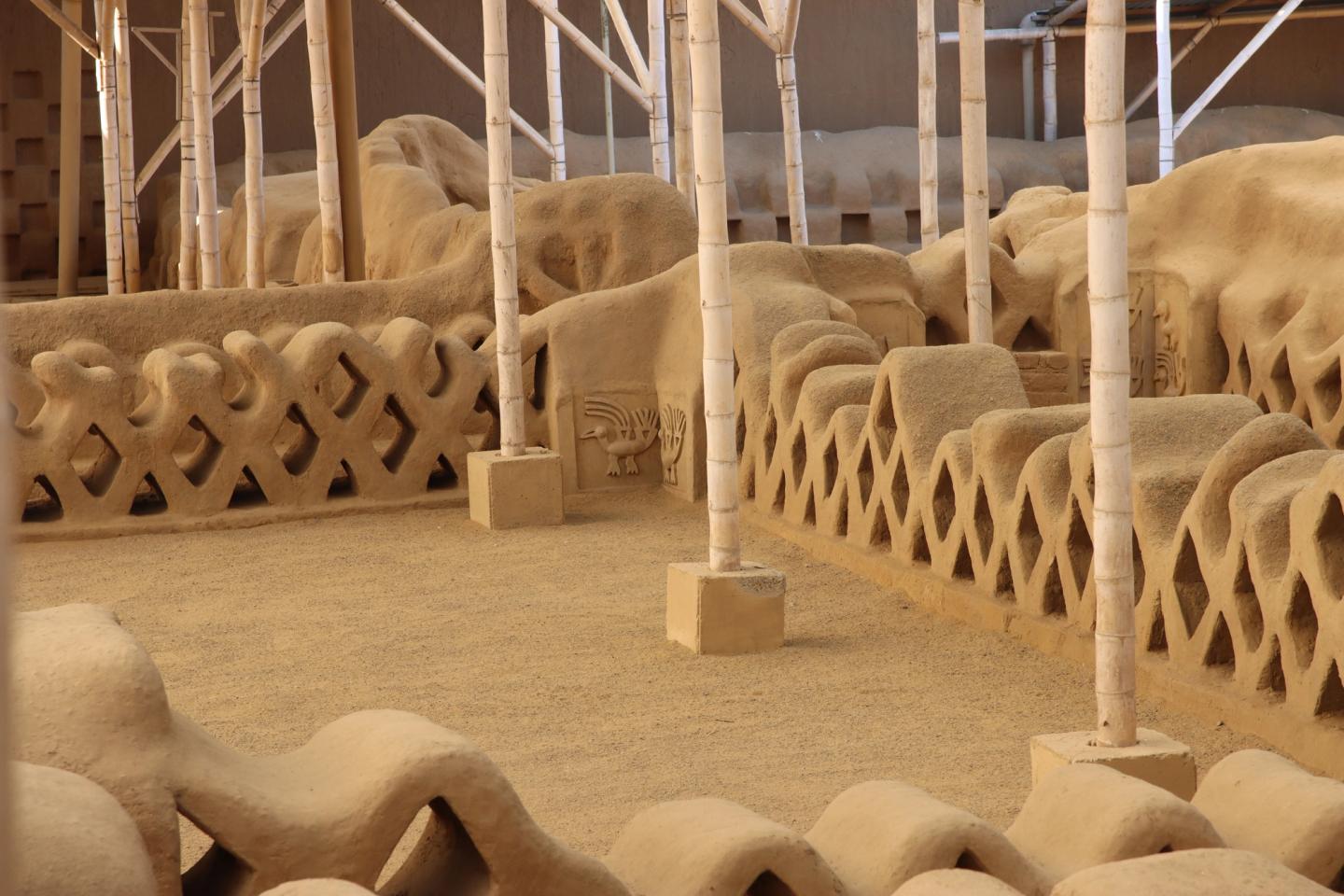
Chan Chan was the Chimú capital and became an immense planned earthen city. High walls enclosed separate palace-like compounds with plazas, storage, reservoirs and funerary platforms. Reliefs with abstract, human and animal motifs belong to that urban order. Treat the open monumental sector and museum as one coherent visit; the archaeological zone is far larger than the route walked by visitors.
The city depended on farming and water management across the Moche and Chicama valleys. Canals, reservoirs and production areas are therefore as meaningful as decorated walls. Adobe is also highly vulnerable to water and extreme weather. Barriers and protective roofs are not visual inconveniences, but part of the site’s survival.
Huanchaco places the coast beside the ruins
Huanchaco shares Chan Chan’s coastal zone but is not an archaeological appendage. Reed fishing craft on the beach, the pier and restaurants make the relationship with the sea visible. Use it as a separate coastal pause or place to stay, and see our place guide for beaches, food and neighbourhoods. Sea conditions and fishing rhythms determine what happens on a given day; a regional route cannot promise them in advance.
The Chicama valley: El Brujo and Magdalena de Cao
El Brujo lies on the coastal side of the Chicama valley. Huaca Cao Viejo preserves Moche reliefs and the burial of the high-status woman known as the Lady of Cao. Huaca Prieta takes the story much farther back, while a colonial church sector adds a later layer. The Cao Museum brings architecture, objects and burial context together. Ask the site manager whether the separate specialised route to Huaca Prieta and Huaca Cortada is available on your visit date.
Magdalena de Cao is several kilometres from the complex and has its own square, murals, crafts and chicha de año. For a short archaeology trip from Trujillo, arranged return transport is simplest. To include the village and coastal valley, allow time for the stop and agree the final local ride explicitly. The separate Magdalena guide develops the complex and village life in detail.
Lambayeque: burial find, museum and pyramid landscape
Sipán has two addresses that explain one another
The royal burials were found at Huaca Rajada, east of Chiclayo, in 1987. The site museum presents the mausoleum landscape and finds from later excavations. Museo Tumbas Reales de Sipán is in the city of Lambayeque, north of Chiclayo, and houses the renowned burial assemblages, jewellery, emblems and clothing. Writing down only ‘Sipán museum’ can therefore take you to the wrong address.
Choose the large museum in Lambayeque when original objects and the reconstruction of court and ritual matter most. Choose Huaca Rajada to understand the findspot and mausoleum too. Combining both in one day is possible, but they are independent visits with a drive between them. Check current admission for each; they have separate management pages and ticket offices.
Túcume shows what followed the Moche
At Túcume, twenty-six earthen pyramids spread around Cerro Purgatorio. The museum and models help make sense of this extensive landscape. Its collection principally covers the final phase of the Lambayeque culture, followed by Chimú, Inca and colonial periods. Túcume is a strong choice for extending the route chronologically, rather than seeing another version of Huaca de la Luna.
Official museum information distinguishes several visitor routes. Ask which sections are open, how long the chosen outdoor route takes and where its path begins. A viewpoint or more distant huaca can involve more walking than the museum alone. From Chiclayo, Túcume is an outing; staying in the village gives the landscape more time and makes an early or late walk easier to arrange.
Build the route around questions, not quantities
- For painted Moche architecture: Huaca de la Luna and its museum near Moche.
- For a planned Chimú city: Chan Chan, with Huanchaco as a separate coastal stop.
- For women’s status and a long coastal history: El Brujo and the Cao Museum.
- For original burial assemblages and metalwork: Museo Tumbas Reales in Lambayeque.
- For the findspot and mausoleum: Huaca Rajada-Sipán.
- For the Lambayeque–Chimú–Inca succession: Túcume and its pyramid landscape.
With limited time, one complex around Trujillo and one key visit around Lambayeque work better than a string of brief photo stops. Children or travellers who reach their limit with adobe sooner can alternate an outdoor site with a museum, coast time or a long lunch. This is not a loss of completeness: the differences between two well-chosen places are more likely to remain clear.
The cooking changes as you travel north
Around Trujillo, look for shámbar, a substantial soup of grains, pulses and meat, and sopa teóloga, traditionally associated with Moche town. On the coast, cebiche and sudado appear alongside fried fish. Use Huanchaco for a meal beside the fishing beach or choose the Moche countryside after the huaca; ask what the kitchen is actually making that day.
In Lambayeque and Chiclayo, arroz con pato and goat stew with beans are central choices. Loche, a local squash, gives sauces and rice dishes a distinctive aroma. Chinguirito resembles cebiche but uses dried, salted guitarfish; king kong is a large layered biscuit cake with sweet fillings such as manjarblanco. A museum morning and an unhurried northern lunch pair better than one more distant site.
Two bases keep the route legible
Trujillo works for Chan Chan, Huanchaco, Huacas de Moche and a longer northern trip to El Brujo. Choose accommodation around the days you will actually make: the centre for city evenings and departures, Huanchaco for coastal time. The place guides cover those neighbourhood and arrival choices in more detail.
Chiclayo offers the broadest transport and dining choice on the Lambayeque side, but Museo Tumbas Reales is in Lambayeque city and Túcume lies farther north. Check every pickup and return point on an excursion. Staying in Lambayeque or Túcume makes sense when the museum or pyramid landscape is the main reason to visit and you do not want to return to Chiclayo each evening.
The transfer is a hinge, not a sightseeing day
Trujillo and Chiclayo share the main northern transport axis. For your date, verify the actual terminal, arrival point and baggage conditions of an intercity bus; a city name does not reveal where the stop is. El Brujo is not automatically on that bus line and requires a detour or separate connection. Use the transfer day for one meal or city walk, not as storage for two archaeological complexes.
Onward to beaches or Amazonas
Beyond Chiclayo the journey divides. The Pan-American Highway continues towards Piura and the northern beaches; routes east lead towards Cajamarca or Chachapoyas. Treat either continuation as a new travel block with its own arrival. The Moche Route does not end because all northern history has been told, but because coastal archaeology gives way to a different landscape and logistics.