
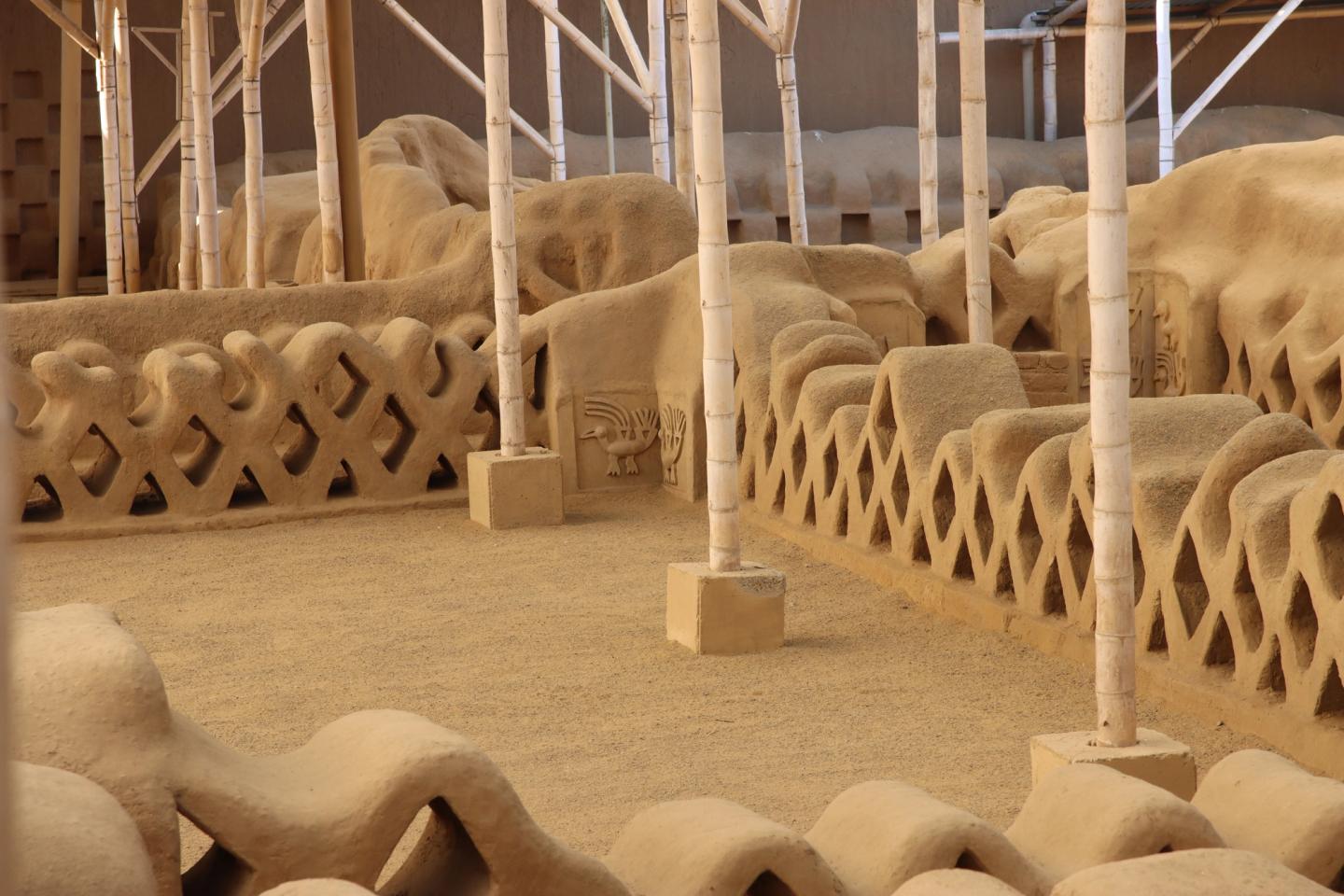

High earthen walls, passages that restrict your view, then an open plaza. Chan Chan expresses power through the arrangement of space. This was the Chimú capital, with walled compounds, workshops and a surrounding landscape sustained through water management. Earth colours dominate. The differences lie in ground plans, thresholds and the patterns worked into the walls.
UNESCO describes dwellings, storage spaces, temples, reservoirs and burial platforms within the major compounds. Chan Chan becomes more interesting when you think of it as a city rather than a collection of photogenic walls. At a threshold, consider who could continue and who remained outside. An open area might raise questions about gathering, work, storage or ceremony. Shape alone does not provide every answer.
Chimú and Moche are different stories
UNESCO places the Chimú kingdom’s peak in the fifteenth century, shortly before the Inca conquest. Huacas de Moche concerns a different, earlier society in the same coastal region. Chan Chan foregrounds urban planning and walled centres of power; Huaca de la Luna brings temple architecture and painted ritual imagery into focus. That contrast gives the two visits a reason to exist in the same journey.
You do not need to memorise a chronology. Keep three questions in mind: who built this, what was the space for and what evidence supports that interpretation? Useful guiding connects a visible detail to one of those questions. If both sites share a day, allow a proper break between them. After several explanations of adobe construction, lunch has a fairly obvious appeal.
Nik An is one visit within a much larger city
PROMPERÚ’s 2023 practical guide identifies Nik An as the walled compound for a Chan Chan visit. You may also encounter its older name, Tschudi. Use that specific name when arranging transport or interpretation. “Chan Chan” can mean the whole archaeological zone. Its wider extent is not an invitation to wander freely, and a list of palaces is not a list of open entrances.
The city’s earthen decoration includes abstract patterns, human figures and animals. Look beyond identifying a creature: notice repetition and the position of a motif within a larger wall. A simple shape can have quite an effect across a broad surface. Ask which parts are original, where conservation is visible and what supports the interpretation being offered.
Maintenance is part of this place. UNESCO’s 2026 decision discusses conservation at Nik An and other complexes and notes a new visitor route. That explains why interventions matter; it does not clear every route for your travel date. Establish which circuit is in use. Protective roofing or an altered walkway need not diminish the visit. Without conservation there would be less left to understand.
Give the museum its own place in the day
The Museo de Sitio is on the road towards Huanchaco. Its own listing describes archaeology from La Libertad, including Moche and Chimú ceramics and material about agriculture, irrigation and crops in the Moche Valley. The museum can help explain a wider landscape that is harder to grasp outdoors. It is a separately named part of the visit; tell your driver explicitly if it belongs in your plan.
The museum listing publishes Tuesday to Sunday, 09:00–16:00. Treat that as the published museum schedule rather than proof that every archaeological sector keeps identical hours. Establish the museum, Nik An, last admission and the scope of the available ticket separately. This helps avoid finishing one component just as the other is closing.
Our suggestion: begin indoors if understanding the whole city is your main interest, then carry one question into the circuit. Start outdoors if the spatial impression is what brought you here, and use the museum afterwards to fill gaps. Neither order is an official requirement. The point is to give the museum more than whichever twenty minutes happen to remain.
Choose what you want to compare next
PROMPERÚ describes La Esmeralda and Arco Iris, also called El Dragón, as separate huacas around Trujillo. Those names do not add a second palace walk inside Nik An: they identify additional destinations. Have a provider name the actual stop and what it contributes. If understanding Chan Chan’s city is your priority, more time for the museum and interpretation may be more useful than another stop.
Huanchaco makes a contrasting next stop after archaeology and also appears in PROMPERÚ’s regional guide. Give it an actual purpose: are you eating there, staying for a walk or simply ending the transport? “Including Huanchaco” is more helpful when it describes something beyond a brief look at a parking area before everyone gets back in.
When arranging an outing, send three clear lines: Nik An with interpretation in your preferred language, the Museo de Sitio with time to look, and any extra stop with a final drop-off address. Ask whether admission and guiding are included and whether the driver is also a guide. A programme with many names can contain less substance than an unhurried morning with a clear explanation of the city plan.
With children, choose a small task: find a repeated motif and follow where it appears again. The same approach works for adults. One question makes a large site easier to take in. Let the broader explanation follow something you have actually noticed. Nobody needs to sit through a complete history lesson before a wall is allowed to become interesting.
Choose Chan Chan for the organisation of an ancient coastal city, rather than because its name happens to sit between two other stops. Nik An, the museum and one well-chosen continuation make a coherent visit. If you want to explore the contrast with Moche history, continue with our Huacas de Moche guide or allow time for El Brujo.
Places to stay in Trujillo
Compare accommodation locations in Trujillo as a base for visiting Chan Chan.