
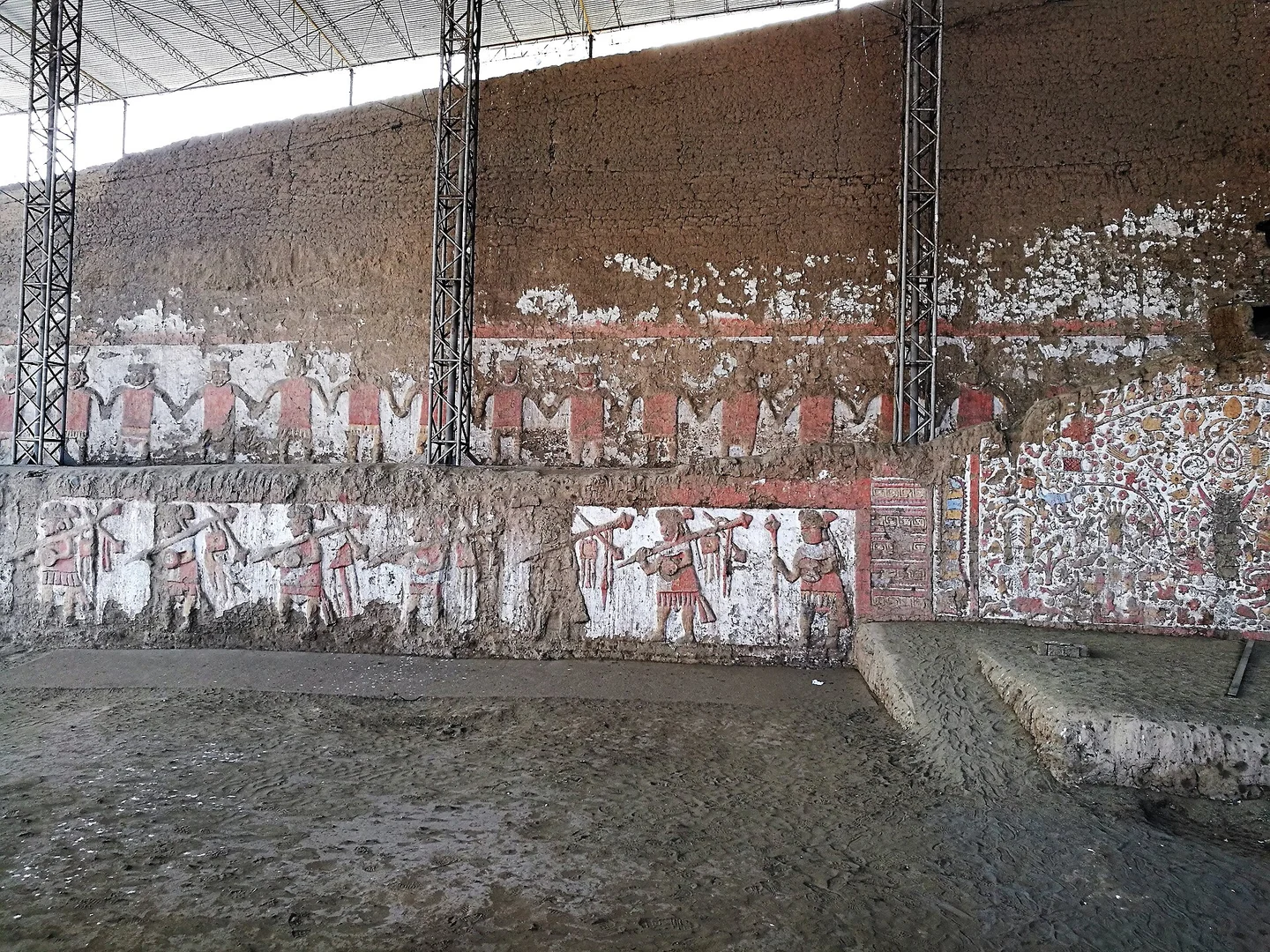

From a distance the huacas can seem like enormous shapes of earth. Painted walls and reliefs change the story: warriors, prisoners, animals and a deity with wide eyes and feline teeth. Huacas de Moche is more than a collection of pyramids. Its monuments, ancient urban area and Cerro Blanco belong to a landscape that brought power, skilled work and ritual together.
The Moche Valley helps explain the setting. The river runs from the Andes towards the coast, and irrigation supported agriculture in an otherwise dry landscape. The archaeological project describes potters, weavers, metalworkers and fishers alongside priests and rulers. Keep that everyday work in mind beside the ceremonial imagery. Food, materials and skilled people were essential to a centre of this scale.
Look at the images as well as the colours
The project website explains several different compositions. The mountain deity mural repeats faces within a chequered arrangement. Warriors and prisoners carry a story through posture, weapons and clothing. The mural of myths combines human, animal and other figures. You do not need to identify every detail. Ask for one scene to be explained carefully before moving to the next.
Ai Apaec is a name you may hear repeatedly, but naming a figure is only a start. Ask how researchers connect an image with ceramics or other finds. What is directly visible, and what is an interpretation? That distinction makes archaeology more interesting. These are surviving materials being studied, rather than a comic strip with a settled answer beneath every picture.
The name does not promise entry to two temples
PROMPERÚ’s visitor information explicitly says that Huaca del Sol does not receive visits and can only be viewed from outside. The project’s own visitor page concerns Huaca de la Luna and the museum. Do not organise a programme assuming that both huacas can be climbed or entered. If the view of Sol matters to you, have the actual circuit explained before fixing your plans.
Sol still matters to the story. The two monuments and the urban area between them help establish the scale of the ancient centre. Do more than compare their size: ask how monumental buildings related to the people living and working around them. A view across the landscape can contribute to that understanding without requiring entry to every structure.
The museum makes the connections
The full name is Museo Santiago Uceda Castillo, honouring one of the archaeologists who led the project. Its own description identifies a principal gallery about Moche culture, the environment and the monuments, a temporary gallery and a gallery about the power of Huaca de la Luna. The point is to connect finds with the complex they came from, rather than simply arrange attractive objects in cases.
The project also describes laboratories, documentation and conservation facilities. Those working areas are not automatically part of a visitor circuit. They explain why an excavated object does not simply pass straight from the ground into a case. When an explanation mentions colour, material or restoration, ask what observation supports it. A small fragment can reveal more than a large object remembered only by name.
We suggest planning the museum and huaca as connected parts of one visit. Begin indoors if an overview helps you, or let the sequence follow the guided circuit actually available. Either way, keep some time to look for yourself. The moment you begin noticing differences may come after an explanation ends. It is easily lost in a timetable already moving towards the next stop.
Use the museum address for your arrival
The visitor page places ticket sales for both components at Museo Santiago Uceda Castillo in the Campiña de Moche. Distinguish that from the project’s office address in Trujillo, which is not the archaeological destination. Give your transport provider the full museum name and the complex’s location. Agree where you will be collected and after which part of the visit.
The project publishes Tuesday to Sunday, 09:00–16:00, with the final group entering Huaca de la Luna at 15:30. The same page specifies cash payment and separate tickets for the huaca and museum. Confirm the current total and guiding arrangements before leaving. Admission to one component does not by itself describe the interpretation or second admission included.
Three arrangements matter more than the number of photographs in an advertisement: the language of the huaca explanation, time left for the museum and responsibility for transport. Establish whether you join a group or have your own guide. This makes offers comparable without assuming that a private vehicle also brings private guiding or museum interpretation.
Let the next stop contribute something different
If Chan Chan follows, keep the distinction in mind: Moche temple imagery and a Chimú city of walled compounds. Our suggestion is an unhurried Huacas de Moche visit, a lunch break and then a decision about more archaeology. If the murals raise questions you want to pursue, there is no need to squeeze another major site into the afternoon.
With children, choose a subject beforehand: recognising an animal, finding a repeated face or comparing an object with its image. Museum interpretation also covers ritual and human sacrifice. You can discuss with the guide which subjects to explore and which to keep brief. This is a choice about the content of your visit, rather than a reason to remove all the historical context.
Huacas de Moche works best when landscape, museum and Huaca de la Luna come together. The vivid figures become more than decoration, and the large earthen forms gain a purpose. El Brujo can extend that Moche thread through Cao Viejo and the Lady of Cao. In Lambayeque, the focus shifts towards the burials of Sipán.
Places to stay in Trujillo
Compare accommodation locations in Trujillo as a base for visiting Huacas de Moche.