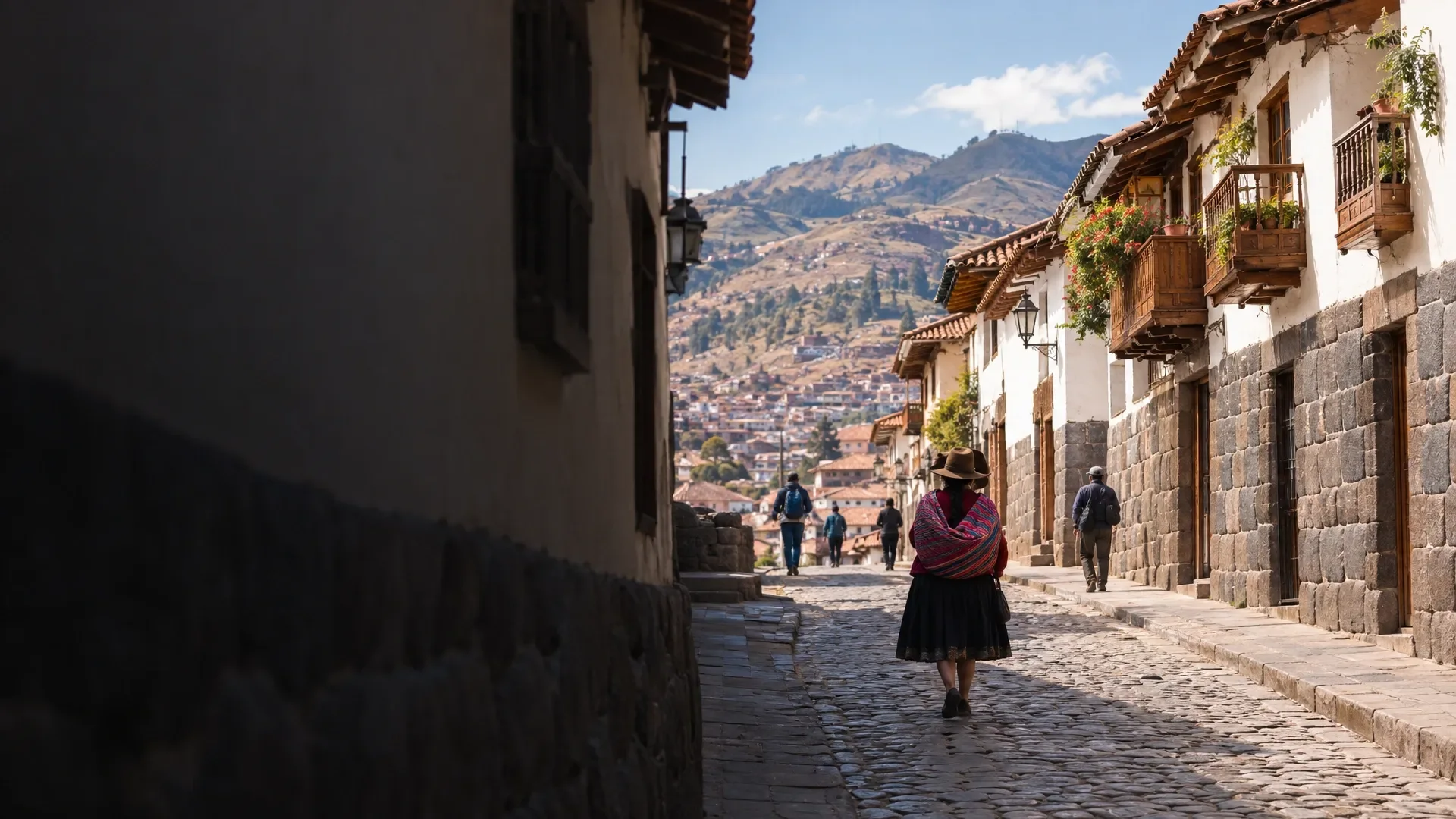
Cusco lies at about 3,400 metres in the Andes. The city spreads across a valley and climbs its slopes, with an old centre of stone walls, squares and colonial houses. Large churches stand around Plaza de Armas; in the streets behind it, Inca stones still fit precisely together. The past sits at eye level here, between the doors and windows of today’s city.
That centre has very different sides. San Blas is made up of narrow, steep streets with craft shops and workshops. In San Pedro, the focus is the market, groceries and food. Above the city stand the large walls of Saqsaywaman. Cusco can therefore fill days with looking, walking and sitting down somewhere, even before the Sacred Valley and Machu Picchu take their turn.
A capital that kept changing
Under the Inca ruler Pachacutec, Cusco grew into the administrative and religious heart of an empire that covered much of the Andes. After the Spanish conquest, churches, monasteries and homes were placed over and beside the older buildings. That explains the combinations visible now: an Inca wall beneath a colonial façade, or a monastery on the site of a temple. The historic centre has been a World Heritage Site since 1983.
Places that give the city its face
Plaza de Armas and its churches
Plaza de Armas is the spacious centre between narrower streets. The cathedral and La Compañía shape much of its appearance. Here, the scale of the colonial church in the former Inca capital becomes clear. A church visit is especially worthwhile if, alongside stonework, you are interested in religious art and interiors. For the streetscape, stay outside longer: walks through the centre fan out from the square.
Qorikancha: temple and monastery in one place
Qorikancha was the Inca Temple of the Sun. Its combination with the later Santo Domingo monastery makes it one of the clearest places to understand the changing city. The carefully finished stonework means more when viewed as part of a religious complex. Give its rooms and their relationship to each other time, rather than looking only at the exterior wall.
There is plenty to see outside the monuments, too. The walls along streets such as Loreto and Hatunrumiyoc make walking through Cusco rewarding without constantly going inside. A guide can explain these building traces; walking independently suits you better if you like changing direction or sitting somewhere along the way.
San Blas: narrow streets and craftwork
San Blas lies higher than the square. The district is known for colonial houses, workshops and craft shops. Its streets are narrow and climb sharply, so a short distance on a map can mean more walking than expected. The visit is about the neighbourhood as a whole, with time to look into a workshop or shop. If you want to buy something, ask how and by whom it was made.
If sleeping among these streets appeals, also look at the final stretch to your hotel. Stairs and the slope are still there after dinner. For anyone who prefers less climbing, staying lower in the centre is a logical choice; San Blas can then be a daytime walk.
San Pedro: a market where the city shops
The covered Mercado San Pedro takes up an entire city block. Alongside food stalls are craft goods and spice sellers. The market building dates from the twentieth century: that too is Cusco, alongside all the Inca and colonial history. It fits well if you are curious about what is sold and cooked, or want to do something different between monuments.
Make it a meal stop if you find a stall that appeals to you. Ask what is being prepared and point to what you would like to try. You do not need to know a complete list of regional dishes. If you would rather sit longer at a table, use the market to look at ingredients and have lunch elsewhere.
Museo Inka: the objects behind the big walls
Museo Inka is housed in the Palacio del Almirante on Cuesta del Almirante. Its collection covers the Incas and cultures that came before them, with ceramics, metalwork and textiles. It is a good counterpart to the buildings outside: how were things made, used and decorated? The collection also includes mummies. Discuss that in advance if you are visiting with children or prefer not to see human remains.
Saqsaywaman: great walls above Cusco
North of the centre, Saqsaywaman sits on a plateau. Its monumental walls are part of a much larger archaeological park, which also includes places such as Q'enqo and Tambomachay. In colonial times, stones from the complex were reused for buildings in Cusco. City and site are connected by more than their location.
This deserves a half-day of its own. Walking links reach the park from San Cristóbal and San Blas, and there are access roads for transport. Decide whether to include the climb or save energy for the site itself. An excursion with several sites gives a wider picture but less time at each place. Look at the actual stops, not only the name “city tour”.
A dish that belongs to a celebration
In Cusco, chiriuchu belongs to Corpus Christi. It is eaten cold and brings together very different ingredients, including corn, cheese, cuy, poultry and cochayuyo, an edible seaweed. It is a celebratory dish that says something about the city and its traditions, not a meal you should expect on every menu at every time.
For ordinary city days, the market and a meal in the centre are good starting points. Choose once based on what you encounter rather than booking every lunch ahead. If you have a particular dish in mind, ask how it is prepared and whether it is being made that day.
How much time should you give the city?
Two full city days are a useful starting point if you want to alternate a few larger visits with neighbourhoods and meals. You might keep the square, Qorikancha and San Pedro together, and combine San Blas with a museum or Saqsaywaman on another day. It is a flexible suggestion; you do not need to fit every visit named here into those two days.
The Sacred Valley, Machu Picchu and higher mountain outings are separate parts of the trip. Distinguish nights in Cusco from days when you are actually in the city. If you are collected early every morning, you can stay several nights and still see very little of Cusco.
Useful for your stay
Use Plaza de Armas, Qorikancha, San Pedro and San Blas as reference points when choosing a hotel. Judge the walking route and slope, not only the distance. If you arrive early, ask about luggage storage and when the room is available. If you head to the valley and return to the same hotel, ask whether part of your luggage can stay behind.
Admission to a monument, a guide and transport are separate parts of a visit. First settle on your own selection, then check the relevant admissions with each location. This lets you combine a church, market, museum and archaeological site without assuming that one tour or ticket covers everything.
Staying in San Blas
San Blas has narrow streets lined with workshops, shops and cafés. Stay here and exploring the neighbourhood starts at your front door.
Antigua Casona San Blas
Antigua Casona San Blas is on Calle Carmen Bajo, with a central courtyard. The walk towards Plaza de Armas takes you down Cuesta San Blas. One detail to check before booking: Expedia flags possible noise from construction next door. Ask the hotel about the situation for your travel dates.
Places to stay on the map
Where is it?
Cusco and the surrounding area.