
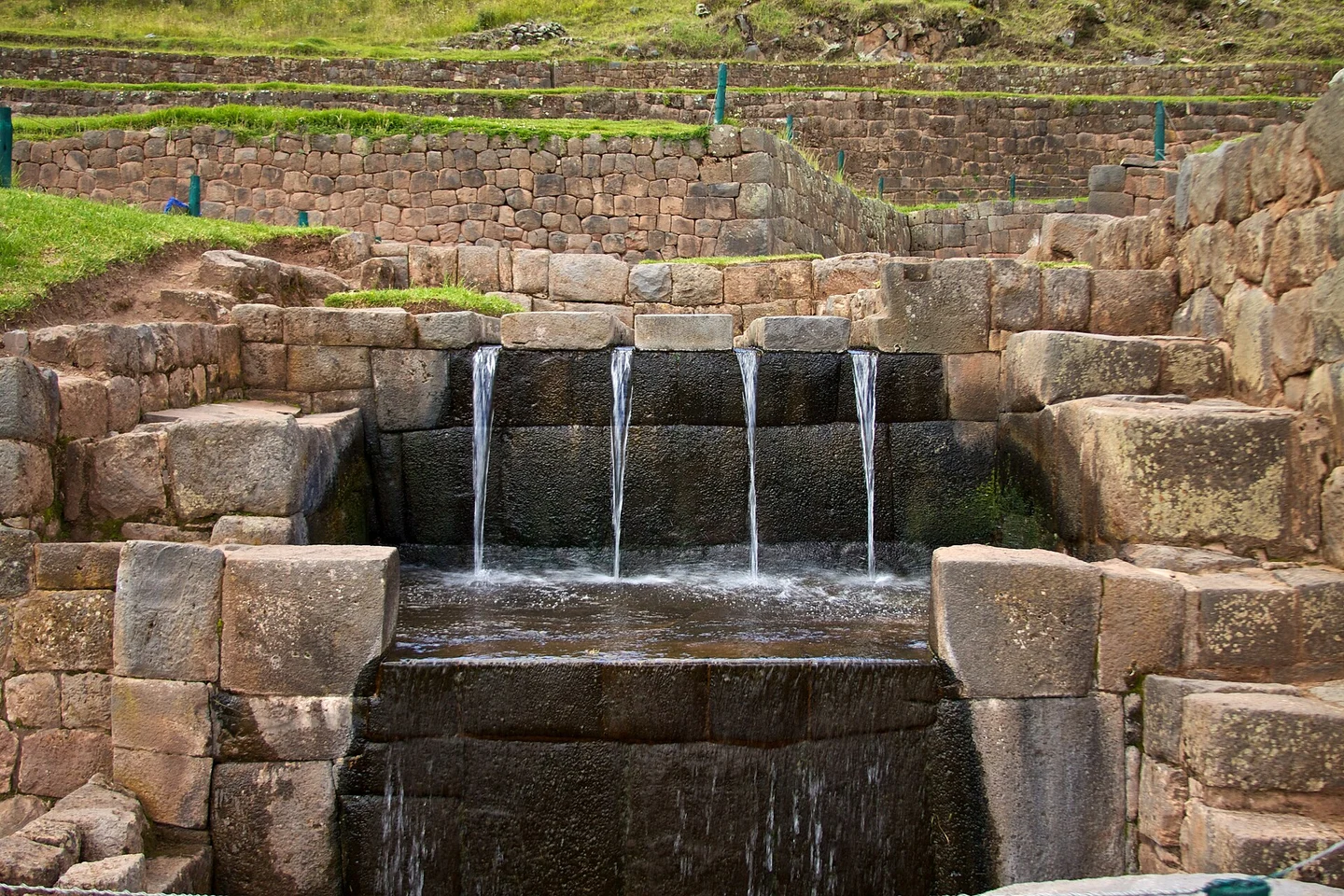
Water is a useful thread to follow at Tipón. Channels, fountains and reservoirs among the terraces connect the buildings with the hillside. This is more than masonry holding something up: it is a designed relationship between landscape and water. That makes Tipón different from a walk around the walls above Cusco. Start by following how water is directed, then look again at the terraces around it.

Agriculture, daily use and ceremony
Cusco’s Dirección Desconcentrada de Cultura describes Tipón as Inca architecture with administrative and ceremonial functions and an important place for the veneration of water. It links hydraulic knowledge with agriculture, ceremony and domestic supply. Keep those functions together. Calling the entire complex only an agricultural laboratory or only a water sanctuary narrows the story beyond the manager’s own account.
First choose a point on the visitor circuit where several terrace levels can be seen together. Then look for a small detail: an opening, a division in a channel or the join between waterwork and wall. The overview shows how much of the hillside was shaped; the detail shows how. Ask a guide to distinguish archaeological evidence from interpretation in one example. It is more useful than immediately assigning a symbolic meaning to everything.
For a focused visit, I would allow an hour and a half to two hours on site, separate from driving and arranging tickets. That is a planning choice rather than an official circuit duration. A shorter visit can concentrate on the relationship between terraces and waterworks. With more time, stay with the details and let the interpretation guide what you want to examine next. The highest or most distant point need not become the automatic goal.
One way to remember the visit is sketching a single waterwork afterwards. Rather than drawing the entire complex, try the point where a channel divides and the terraces around it. It reveals which parts you actually understood. With companions, compare what each person noticed. One may see the pattern in the landscape while another remembers a small construction detail. Combining those observations suits Tipón particularly well.
The road junction is not the archaeological entrance
Tipón is near Choquepata in Oropesa district. The cultural authority describes a separate approach from the Cusco–Sicuani road through the village to the park’s parking area. Arrange transport to the actual entrance and agree on waiting or collection. Getting out at the Tipón junction leaves another stretch to cover. Do not turn a map distance into a fixed driving time; your starting point in Cusco and chosen stops also shape the day.
The published access description includes rocky ground and a wooden staircase. Discuss the actual circuit with the manager and transport provider if you have specific walking or assistance requirements. A parking area beside an archaeological park says little about the circuit beyond it. Have the chosen route described rather than relying on a broad label such as “short stop”. It also makes the agreement about time on site more concrete.
Tipón or Pikillaqta: two different reasons to go
Tipón focuses attention on terraces and the management of water. Pikillaqta reveals the scale and layout of a planned Wari city, earlier than the Incas. If landscape engineering and technical details appeal most, make Tipón the main visit. If the question is what existed around Cusco before the Incas, Pikillaqta offers a strong reason to go. Combining them is meaningful when those differences are what you want to explore.
What does this mean for your travel day?
For both sites, avoid squeezing the visits, driving and a meal into a tightly fixed half-day. I would leave a generous day from Cusco if giving both proper attention. That is not a fixed itinerary or a promise that every stop fits. Start with the place that matters most to you and arrange the second around it. Do not automatically add churches, museums and villages simply because they appear on the same excursion list. Pikillaqta: a planned Wari city south of Cusco
COSITUC includes Tipón and Pikillaqta in Circuit II alongside city visits. Compare the partial ticket with the integral boleto according to your other Cusco plans. Its FAQ explicitly excludes guiding and transport from the boleto. For an excursion, have the provider state whether it supplies only transport or also the appropriate ticket and a guide. A seat in a vehicle and a complete visiting arrangement are different purchases.
Places to stay in Cusco
Compare the locations of places to stay in Cusco as a base for visiting Tipón.