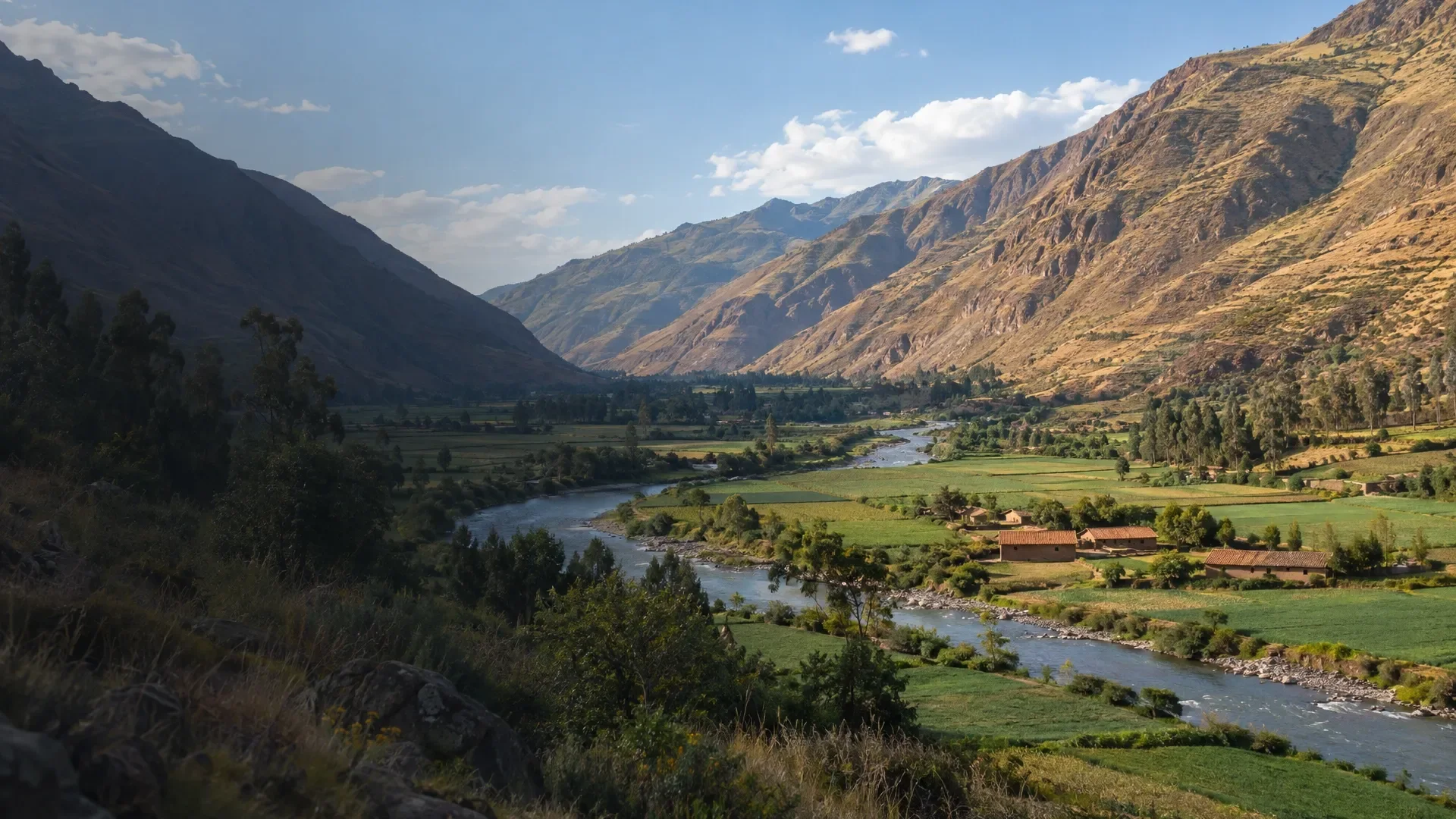
In the Sacred Valley, villages and farmland follow the Urubamba River, with terraces and archaeological sites on the slopes above. The valley connects major Inca structures with places where people still live and work. In Ollantaytambo, the old street layout runs through the town; around Urubamba, agriculture has more room.
Chinchero, Moray and Maras lie higher and farther from the river. Here the view shifts from weaving and old walls to circular terraces and salt ponds on a hillside. Those differences make the valley worth a longer stay: a village walk, an archaeological visit and seeing how salt is produced each give a day a different focus.
From the river to the higher villages
Pisac: buildings, squares and temples
Above Pisac, archaeological buildings, squares and temples occupy the hillside. The terraces show how the structures fit into the landscape. The village below has its market and streets to explore. Think of the village and archaeological site as separate visits when arranging transport.
Urubamba: a town in the middle of the valley
Urubamba sits almost at the centre of the Sacred Valley in the Vilcanota-Urubamba basin. It was associated with agriculture and adapting crops to different altitudinal zones; agriculture remains important. That makes Urubamba more than a lunch break between famous sites.
Ollantaytambo: town and archaeology
Ollantaytambo is both a traditional town and the setting for a major archaeological complex. Its Inca town structure, terraces and rail connection are three different reasons not to pass straight through. Staying overnight lets the lanes and water channels stand apart from a train departure; passing through shows how closely town and railway meet here.
Chinchero: a village with weaving traditions
Chinchero has weaving traditions and a history explored in its local museum: from Inca settlement and a palace through the colonial period to today's communities. At a weaving centre, ask about the fibres, colours and techniques behind the work. This gives a purchase or demonstration more context.
Moray: farming in circles
Moray has three large, roughly circular depressions with concentric terraces. Water management, drainage, soil and variation between levels point to specialist agricultural management; its interpretation as a place for crop experiments is well supported, not a final certainty. The circular form alone is not the whole story.
Maras: salt and channels
At the Salineras de Maras, salty water runs through channels into open evaporation ponds arranged down the hillside. A spring and the distribution of its water make salt production possible here. The work is connected to the communities of Maras and Pichingoto. From the visitor route, you can see how the ponds function as one system.
Staying in the valley, not just passing through
Pisac and Ollantaytambo sit at different sides of the valley and offer different views of Inca building. Urubamba lies between them and is a useful base for seeing more than one side of the valley. Chinchero, Moray and Maras are higher up and form a group of their own. For a later Machu Picchu journey, Ollantaytambo makes sense for its rail connection; Chinchero points more naturally back towards Cusco.
Staying by Ollantaytambo station
Ollantaytambo can be a useful overnight stop around a train trip to Machu Picchu. This option is by the station, not in Urubamba or elsewhere in the valley.
El Albergue Ollantaytambo
El Albergue sits at Ollantaytambo train station, with a garden and restaurant. That makes it a practical choice when catching a train here. There is a trade-off: several guests mention train noise, even in otherwise positive reviews. Choose it for the station location, not for a promise of silence.
Places to stay on the map
Where is it?
El Albergue Ollantaytambo and the surrounding area.