
After a day among terraces and mountain slopes, where would you like to return: the streets of Cusco, the square in Ollantaytambo, or a hotel garden near Urubamba? That is a useful starting point when choosing accommodation in the Sacred Valley. Where you sleep also determines which journeys you repeat the next morning.
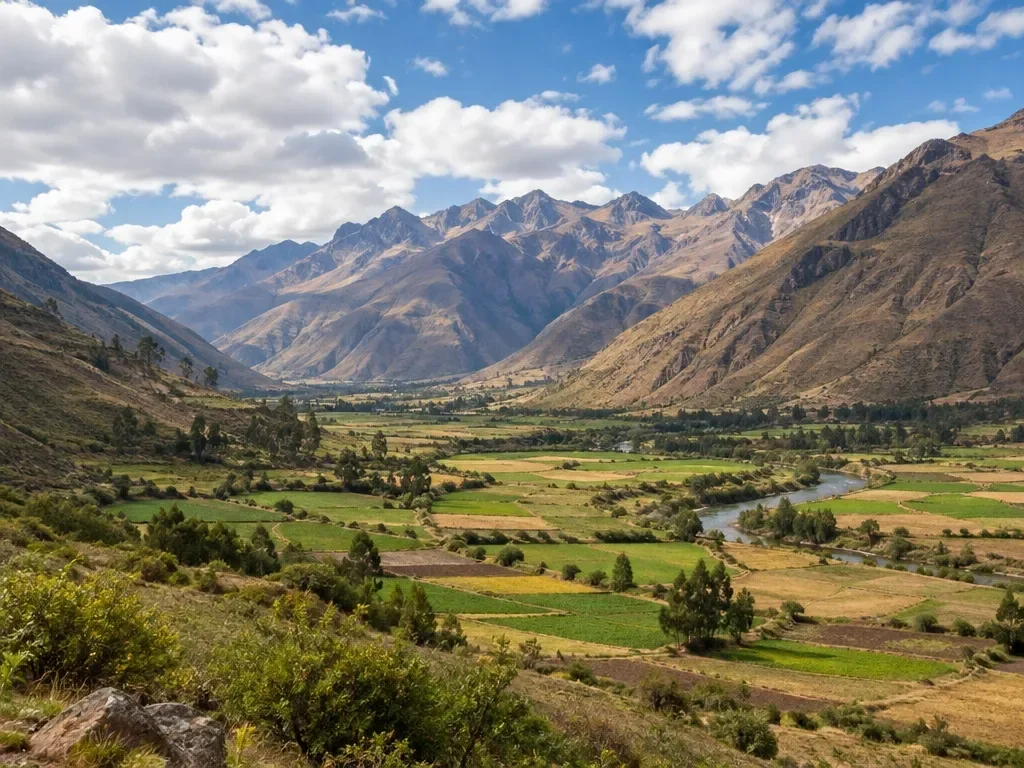
Choose Cusco when the city itself is a substantial part of your trip. Ollantaytambo makes sense if you want to explore the town and have booked a train from there. Urubamba suits several days in the valley, especially if you want time at your accommodation too. Combining two bases can help; moving your suitcase for every outing usually adds more work.
Cusco: leave room for actual city days
Around Plaza de Armas are churches and streets with Inca stonework. San Blas involves an uphill walk; Qorikancha tells another part of the city’s story. A central base lets you spread visits across the day and return to your room between them. Your address within Cusco matters: look at the slope and the final street to the hotel, particularly if you will arrive with luggage.
Keeping one hotel in Cusco saves packing and checking out, in exchange for return journeys to the valley. That can be a reasonable trade if you want one valley outing and will spend your other days in the city. For two consecutive days around Urubamba and Ollantaytambo, compare those repeated journeys with a single hotel move. Several nights in Cusco do not amount to much city time if you leave every morning.
Ollantaytambo: time in the town and a night near your departure station
Ollantaytambo has an archaeological complex with terraces, as well as an old settlement with squares and the neighbourhoods of Qosqo Ayllu and Araccama Ayllu. Give it an afternoon or a full day of its own. Arriving late and catching an early train mainly gives you somewhere to sleep, with little time left for the town and the archaeological site.
If your train ticket starts in Ollantaytambo, staying here removes the journey from Cusco or Urubamba before that train. Then check the walking route from your particular hotel to the station. A room near the railway and an address near the square serve different priorities: reaching your departure point or strolling around town after dinner. Consider your luggage, the time you must arrive and the route to the entrance before booking.
Urubamba: the hotel address matters as much as the town
San Pedro Apóstol stands by Urubamba’s main square. The Museo de Qespiwanka, in Casa Hacienda Pino, explores the Qhapaq Ñan road network, the Inca palace and the later hacienda. These give you reasons to spend time in the town itself. Moray’s circular terraces near Maras are a separate outing. Staying in the valley need not mean filling every day with the same kind of archaeological visit.
For accommodation outside the centre, think through an ordinary evening. Can you eat there, will you use the garden, and how will you arrange a ride into town and back? A central address may suit you better if you like walking out to find dinner. A hotel outside town may be right when you want to set aside time for the property itself. Check the actual location: ‘Urubamba’ in the name does not tell you how much transport you will need each day.
Group visits along your journey
The culture authority describes two roads from Cusco to Ollantaytambo: via Chinchero and Urubamba, or via Pisac, Calca and Urubamba. That gives you a choice when moving hotels. If you want to visit one of those places, arrange a journey that includes time there. Moray requires a side trip via Maras; include it explicitly rather than assuming it falls naturally along the way.
Compare the same elements when arranging transport. A direct journey takes you to your hotel or station. For an outing, waiting time, stops and the final destination also need to be clear. If you use shared transport, ask where you board and get off, and how to cover the last stretch to your hotel. A lower fare is less helpful if you still need a separate transfer afterwards.
Your hotel town is not necessarily your station
Urubamba, Ollantaytambo and Pachar are separate stations, listed individually by PeruRail. Start with the name on your ticket, even if your accommodation is in the same valley. A departure from Ollantaytambo still requires a journey there from a hotel in Urubamba. Check where your return journey ends before booking the next hotel night too.
PeruRail uses ‘bimodal’ for a combination of bus and train from Cusco. Compare that with a ticket requiring you to reach the departure station independently. Read the departure address, transfer point and included journeys on the booking for your date; the general product name does not give you every detail. Our separate guide to reaching Machu Picchu explains the connections and arrival in Machupicchu Pueblo in more detail.
Divide your nights without moving constantly
With four nights for Cusco and the valley, one option is two in Cusco and two in Ollantaytambo. That gives each a full day between arrival and departure. Add time in Cusco if you want more city visits. If you prefer varied valley outings and an afternoon at your hotel, Urubamba could be your second base. These are flexible suggestions: a Machu Picchu visit and any night in Machupicchu Pueblo still need to fit into your days.
One night in Ollantaytambo may be enough if your main aim is to sleep in the town before a booked train. A second night helps if you want to visit both the archaeological site and the town without squeezing them between arrival and departure. There is little reason to move to Urubamba as well simply to try all three bases. Add that move when the location or accommodation genuinely adds something to your plans.
Decide where your suitcase needs to be after the train
If you return to the same hotel after Machu Picchu, ask whether you can leave larger luggage there and when you can collect it. A return journey ending in Cusco while your suitcase is still in Ollantaytambo creates another journey. Travelling onwards only works smoothly if your luggage is part of the plan. Check your carrier’s own baggage conditions too; storage at a hotel is a separate arrangement.
Before booking, put three things side by side: the days you will actually spend in Cusco or the valley, the full hotel address, and the departure and arrival points of your train or transfer. Then choose the room. Book Machu Picchu yourself or choose a package?
Cusco and the Sacred Valley: places to stay
Choose Cusco, Ollantaytambo or Urubamba to compare accommodation locations.