
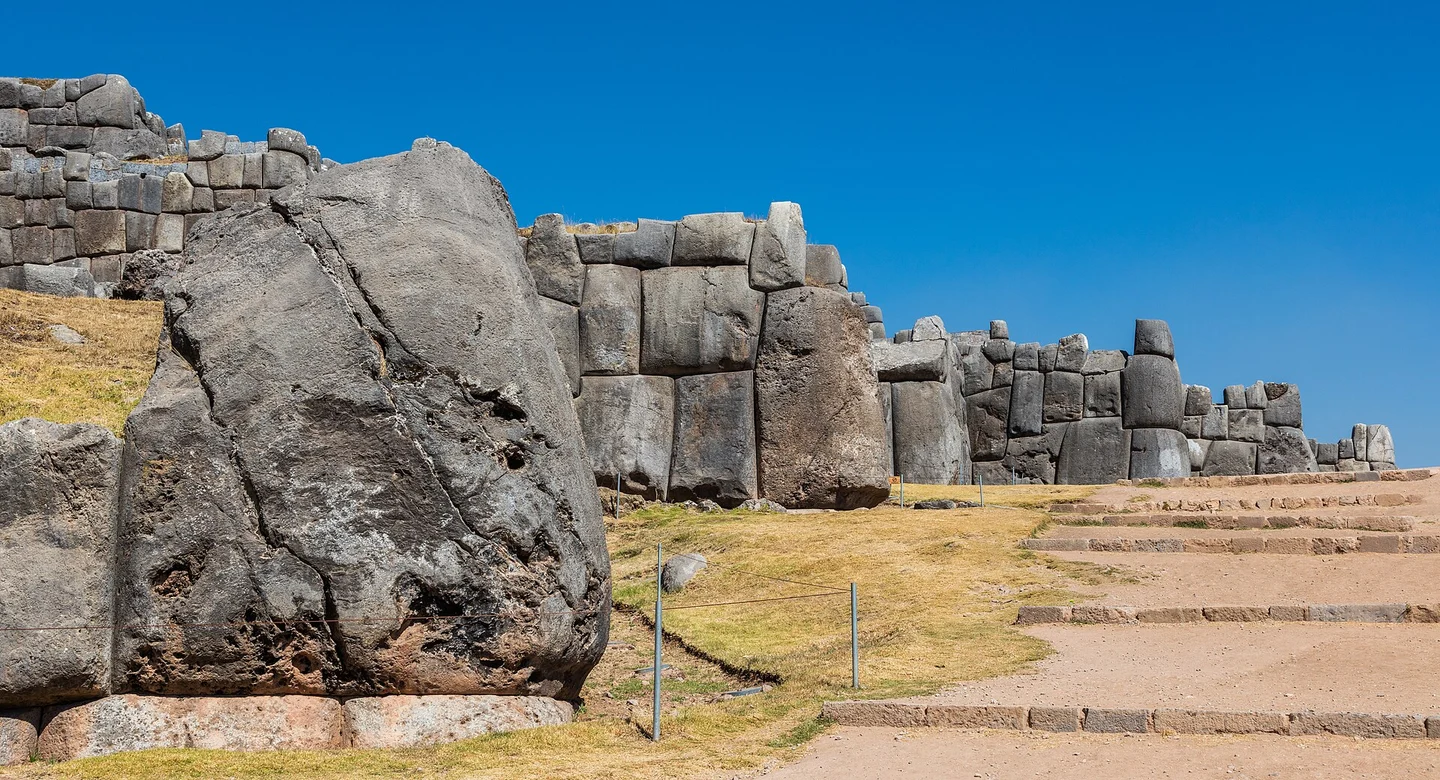

At Sacsayhuamán, the scale registers before the explanation does. Huge blocks form walls whose joints change direction from one stone to the next. Step back and the lines of the structure become clearer; look closely and individual stones take over again. Cusco is nearby, but the site puts the city into a different part of its history.
The famous walls are only part of that story. This was a landscape of ceremonial places, waterworks and connections with other sites around the Inca capital. Calling it a fortress alone leaves much out. A visit devoted entirely to a viewpoint photograph misses the opportunity to connect the masonry, the surrounding ground and the city below.
More than a fortress above Cusco
Cusco's cultural authority describes Sacsayhuamán as the Casa del Sol of Hanan Qosqo. According to the authority, construction began under Pachakuteq and continued under his successors. That places the monument within the world of royal families, religion and the organisation of the capital. A guide who starts by asking what all this work was for gives you more to consider than a series of impressive stone weights.
The same authority describes routes between sacred places and an extensive system for collecting and distributing water. You do not have to seek out every channel to appreciate why that matters. The monuments were not isolated objects in an empty landscape. Ask how buildings, water and surrounding agriculture related to one another; smaller traces can then become interesting alongside the enormous walls.
Some stones were reused in churches and large houses in Cusco during the colonial period. What survives is therefore not a complete original complex. Keep that in mind when looking at drawings or reconstructions of vanished buildings. Ask which elements remain and which parts of an explanation reconstruct an earlier appearance. An empty space can become as revealing as a standing wall.
Look at the whole, then the joints
Start your attention with the Baluartes, the famous zigzag walls. First take in the pattern of successive terraces, then choose a small section to study. Follow a changing edge with your eyes and see how the next block meets it. There is no need to touch the masonry or climb onto anything. Moving between an overall view and an individual detail gives the visit a useful rhythm.
The manager also names Muyuqmarca, the Rodadero and the Chinkana within the monumental area. Treat these as questions for your guide, not a promise that you can or should enter every part. Ask staff to indicate the current visitor route and explain which elements it reaches. A shorter, well-explained circuit offers more than pursuing names without understanding what you are looking at.
Leave a moment to consider the relationship with Cusco as well. Alternate looking at the walls with looking at the ground around them. Which side connects with the city? Where is there space between structures, and what changes when you move a little farther along? You need not remember a date for every answer. The aim is for Sacsayhuamán to become more than another photograph of Inca masonry.
A dedicated visit or the four-site tour?
For editorial planning, we would leave roughly one and a half to two hours for Sacsayhuamán itself, excluding transport and ticket purchase. That allows room to listen and look back; it is not an official circuit duration or a promise for every walking pace. If lengthy explanations do not interest you, choose a more compact walls-focused visit. If context matters, reserve time for other elements instead.
A four-site proposal may combine Sacsayhuamán with Q'enqo, Puka Pukara and Tambomachay. Ask how much time each receives and which journeys are included in the advertised duration. Four names do not necessarily mean four substantial visits. You can make Sacsayhuamán the main stop and choose one addition, or leave the others for another occasion. A ticket covering more places does not oblige you to complete them all that day.
The cultural authority describes connections from old city neighbourhoods as well as vehicle approaches. Agree on the actual entrance and pickup point with your transport provider. Driving uphill is different from a level circuit around the site; if walking conditions matter, ask about the selected route, steps and ground surface. Arrange the return too if you do not want to retrace the same journey. Proximity on a map cannot settle those details.
What admission does and does not include
COSITUC places Sacsayhuamán in Circuit I with Q'enqo, Puka Pukara and Tambomachay. Compare the corresponding partial boleto with the integral ticket against your actual itinerary. Check the applicable category, validity and supporting documents with COSITUC. A published fare category does not allow us to determine your individual entitlement to a discount or admission.
According to COSITUC's FAQ, guiding and transport are not included in the boleto. Ask a tour supplier to set out the ticket, guide, transport and time on site separately within its price. Check the current visiting hours and route with the manager as well. Otherwise one company's offer may include admission while another is quoting for the vehicle seat alone.
Give the remainder of your Cusco day a different emphasis. A meal, time in the centre or a shorter museum visit may be a better companion than another four stops. Choose Sacsayhuamán when you want to understand how monumental Cusco extends beyond its present streets. The great stones draw attention on their own. The connections between them deserve some time.
Places to stay in Cusco
Compare accommodation locations in Cusco as a base for visiting Sacsayhuamán.