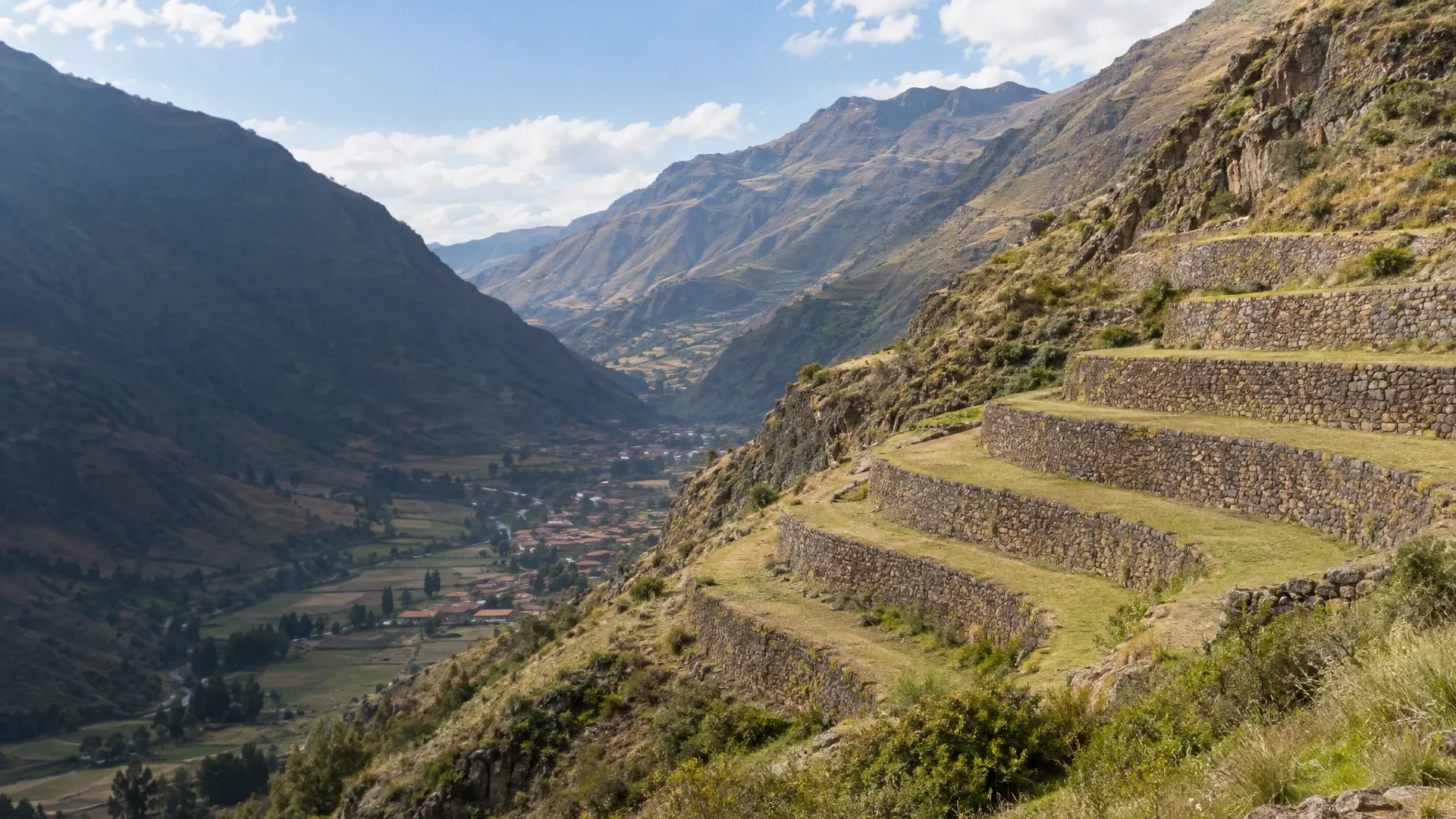
Pisac has two very different faces. High above town, terraces curve around the slopes and stone buildings spread across the mountain. Below, life gathers around Plaza Constitución, shops, market trading and food. The broad shapes of the landscape and the small objects on a market table belong to the same place.
You will also see the name written as Pisaq, especially for the archaeological park. This end of the Sacred Valley brings together farming, old stonework and present-day trade. There is more variety here than ‘ruins and souvenirs’ suggests: climb towards the landscape, look for something to take home, then stay in town for lunch.
The mountain formed an entire estate
The culture authority describes Pisac as a royal estate associated with Pachacutec and his kinship group. Agricultural terraces, homes and ceremonial places were spread across the site. Look beyond the most impressive wall. The distance between structures and their placement on the mountain help explain how extensive and varied the estate was.
The terraces deserve particular attention. They make the slope usable and establish the rhythm of the view, their long lines following the land's contours. It is tempting to treat them as a backdrop to the buildings, yet farming was central to the site's design. Pause at a permitted spot on the circuit to take in that relationship.
Driving up does not remove the walking
The park road climbs beyond the town. A ride to the entrance saves the approach on foot, but does not make the site level. The culture authority describes narrow ground and steps cut into rock. Wear shoes that are comfortable on uneven stone.
Decide whether you want an out-and-back visit from the entrance or a longer walk. The connections between sectors matter: an old account of descending all the way into town does not establish that the route is open. If a driver is waiting, agree your meeting point around the permitted circuit. A guide can help explain the landscape and construction, not simply show the way.
There is more than one kind of market
Pisac is known for crafts and souvenirs, but its Sunday market also has an agricultural side. The municipality describes producers from town and neighbouring communities selling their produce on Plaza Constitución. That offers something different from browsing scarves or jewellery: you can also see what the surrounding countryside supplies.
If the producers' market is your main interest, Sunday gives the visit a clear focus. When shopping, a conversation about materials and the maker is more useful than finding the supposedly definitive market day. Where was it made, what is it made from and who made it? You do not have to buy at every stall to look with interest. A stall is also a workplace, not a setting where everyone automatically wants to be photographed.
Plaza Constitución and lunch in town
The square is the natural starting point for the town part of your visit. Walk out towards the shops and return for somewhere to sit. After the archaeological site, the change is welcome: on the mountain you followed the terrain; here you can decide when to get up again. Even without a major purchase, town need not be a hurried stop.
Cuchara de Palo, inside Pisac Inn on the square, also welcomes people who are not staying at the hotel. Its Andean-influenced menu lists quinoa soup, trout and vegetarian dishes among the options. There are several seating areas, including a courtyard and balcony. It gives you a specific option for a longer lunch instead of eating while already searching for transport.
The everyday Mercado de Abastos also has food stalls and sections selling groceries. Choose it if you mainly want to see ingredients and cooking. Travel accounts sometimes blur the craft market, producers' market and everyday food shopping together. When asking directions, say what you are looking for: crafts, farm produce or a meal.
A day trip or an overnight stay?
A full day from Cusco leaves room for both the park and town. A market-only visit misses the mountain; staying entirely at the ruins misses the present-day settlement. On a whole-valley excursion, ‘Pisac included’ is therefore not enough detail. Look for which part is visited and how much time remains in town.
Stay overnight if you want to spread out the visits or spend an evening and morning around the square. An address near Plaza Constitución keeps food and shops close. Accommodation outside town may offer a different setting, but transport becomes part of an ordinary evening. Choose that deliberately, especially if you like walking back after dinner.
From Cusco to Pisac, then along the valley
Pisac is on the road from Cusco to Calca. The archaeological park is not immediately beside it: the culture authority lists about nine further kilometres of road from town to the park. Specify whether your transport is to the town, the archaeological entrance or both. Otherwise you may have ‘arrived in Pisac’ while your main visit is still farther up the mountain.
For an onward journey, follow the valley through Calca to Urubamba and then Ollantaytambo. Pisac works as a first valley stay, but is less convenient for an early train from Ollantaytambo. Moving accommodation for a night may be more pleasant than covering the same road before dawn.
One workable day starts at the archaeological site, followed by lunch and town. On Sunday, reverse the order if the producers' market is your priority. Keep the return ride from the park as a definite arrangement. You can leave the market whenever you like; up on the mountain, you want to know where your transport will be.
Places to stay in Pisac
Compare the locations of places to stay in and around Pisac.
Where is it?
Pisac and the surrounding area.