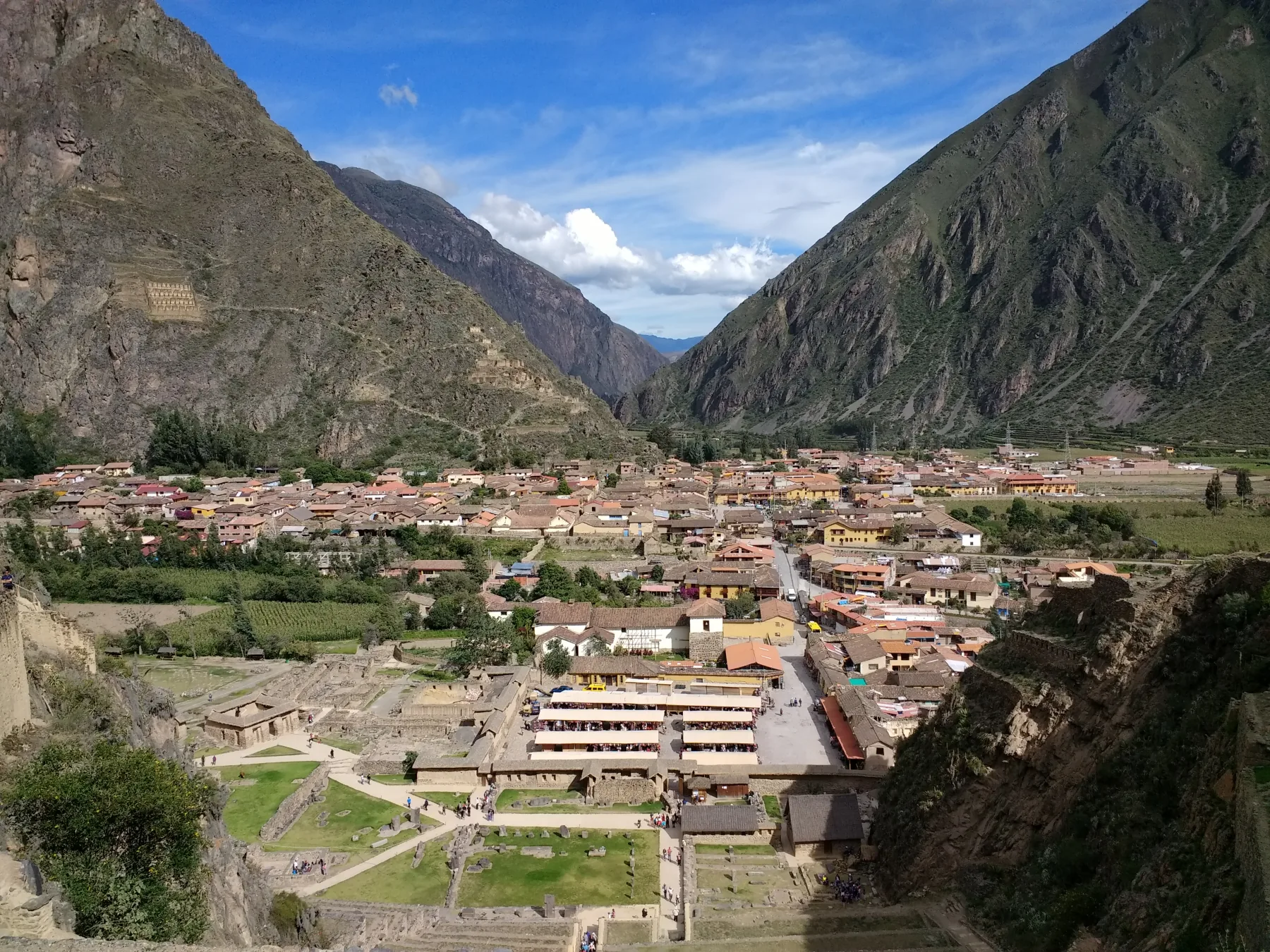
Mountains press close around Ollantaytambo. Terraces and large stone walls rise above the houses; across the valley, old storehouses cling to another slope. Daily life continues between them. The interest is not confined to the archaeological site's entrance: it extends into the buildings and streets of the present-day town.

The station puts Ollantaytambo on many journeys to Machu Picchu. Suitcases, departure times and a quick meal all belong to the scene. Yet the town has enough character to take your mind off the train. From below, you look up at the monuments; from higher ground, you see how the settlement fits between the mountains.
A planned Inca settlement, not an isolated ruin
Ollantaytambo combined residential, agricultural and ceremonial areas. Qosqo Ayllu and Araccama Ayllu were important parts of that settlement. Terraces, storage buildings and living quarters belong to the same story: people needed homes, crops and supplies. That is more revealing than the simple ‘fortress’ label used on many excursion itineraries.
The terraces and the Temple of the Sun
The main archaeological complex is the visit that takes you uphill. Terraces give the slope its distinctive shape; higher up stand the six massive stone blocks of the Temple of the Sun. Look beyond their size to the contrast between carefully worked stone and the sheer quantity of building material. How was all this moved into place? Questions like that are a good reason to visit with a guide.
Allow a morning or afternoon if you enjoy looking closely and hearing the background. Climbing to the upper structures is a different visit from exploring the lower area. The culture authority also describes a short, level circuit with an entrance ramp. This does not mean the Temple of the Sun is accessible that way; if mobility is a concern, discuss the particular sections you want to see.
Qosqo Ayllu: beyond the square
After the main site, spend some time in town. In Qosqo Ayllu the old settlement appears on a smaller scale: streets, passages and buildings rather than an entire mountainside. Look at the arrangement of the buildings as well as the tallest walls. The idea of an Inca town becomes tangible without another monument visit.
Start at the square and follow a few streets into the old neighbourhood. This can be a walk between larger visits or the whole plan for an unhurried afternoon. Distinguish public streets from private spaces: an interesting doorway may lead into someone's home. A photograph of a building is not a reason to walk into its courtyard.
Pinkuylluna, on the opposite slope
The rectangular buildings on the eastern slope belong to Pinkuylluna. They are interpreted as colcas, or storehouses. While the main complex draws attention to terraces and temple construction, this side introduces the settlement's supplies. The buildings already form part of the view from town.
A footpath climbs from Qosqo Ayllu. Choose it for a hillside walk and a different perspective on Ollantaytambo, rather than automatically adding a second climb after the temple complex. Ask locally which access is open that day; a path to archaeological buildings is not a guaranteed freely accessible viewpoint. Looking from below and spending the afternoon in town is an option too.
Lunch beyond the station sandwich
El Albergue offers a pachamanca lunch at its farm, with ingredients cooked in an earth oven. This is a meal to set time aside for. Chuncho uses regional ingredients and a menu that changes with the season. They offer two different ways to explore the valley through food, without turning every meal into an excursion.
For coffee or something smaller around a train journey, Café Mayu is on the station platform. For the farm lunch, make a booking and agree where to meet rather than arriving with luggage just before departure.
Stay near the town or the railway?
Choose the centre if evening walks and the archaeological visits are your priorities. An address by the station makes more sense when an early train is the main appointment. Look at the actual walking route with luggage. An Ollantaytambo address or a ‘near the train’ description does not tell you how easily you can reach the platform from your room.
One night works when you arrive during the day, explore town and continue the following day. Two nights give you a full day for the main site, a long lunch and Qosqo Ayllu, with Pinkuylluna as an alternative to part of that plan. Arriving late and leaving early mostly gives you somewhere to sleep. That is fine, but it is not the same as visiting Ollantaytambo.
Fitting Ollantaytambo into your journey
Two main roads connect Cusco with Ollantaytambo: through Chinchero and Urubamba, or through Pisac, Calca and Urubamba. The second takes in more valley towns. You can build a travel day around a stop along the way rather than repeatedly returning to Cusco. Agree whether a transfer includes sightseeing time or is simply a direct journey; these are different services.
For Machu Picchu, the train takes you to Machu Picchu Pueblo, also called Aguas Calientes. You still need to travel from that town to the archaeological site. A train ticket is therefore not a Machu Picchu admission ticket. Check the actual departure point on your booking too: a bus-and-train service from Cusco differs from boarding independently at Ollantaytambo station.
Station access matters particularly for journeys in autumn 2026. PeruRail announced roadworks from 13 April, expected to last around eight months, with changes to the approach road and some bus-and-train services. Have your driver work from the current departure information for your train rather than an old standard journey time.
Places to stay in Ollantaytambo
Compare the locations of places to stay in and around Ollantaytambo.
Where is it?
Ollantaytambo and the surrounding area.