
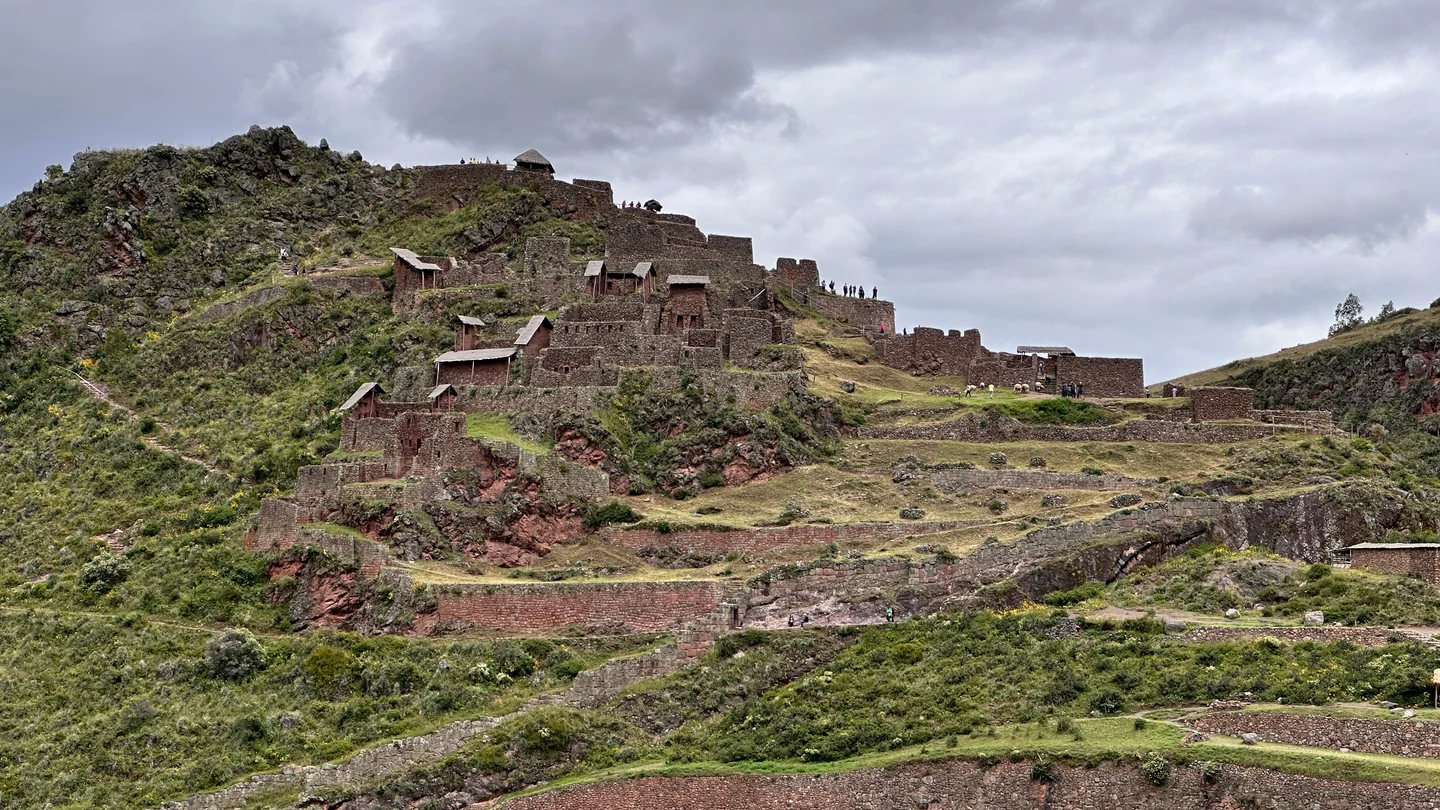

At Pisac, the buildings follow the mountain. Terraces cover broad sections of slope; elsewhere, residential remains and ceremonial buildings occupy their own positions. The valley stays part of the view. This is not simply a ruin that happens to have an attractive backdrop. The way people used the terrain is one of the main reasons to come up here.
The town and market below tell a different story from the archaeological complex. Both can have a place in your day, but they are not interchangeable. An itinerary labelled only “Pisac” may mean shopping, a brief terrace stop or a much longer archaeological circuit. If the mountain is your reason for coming, you need more information than that single name on an excursion list.
A landscape with several purposes
Cusco's cultural authority describes Pisac as a probable royal estate of Pachakuteq and his kinship group, referring to the chronicler Sarmiento de Gamboa. That interpretation helps explain the dispersed buildings: agricultural terraces, houses and ceremonial places formed parts of a larger whole. Think beyond one temple on a hill and look instead at a landscape where several functions belonged together.
Give the terraces your attention first. Where do they follow the slope, and where do they create a more geometric shape? MINCETUR's tourism inventory identifies the Acchapata terraces among the features. Use the name for orientation rather than as an instruction to walk every level. A broader view can reveal how much work went into reshaping the mountainside.
MINCETUR also distinguishes building groups including Qaschis Raqay, K'alla Q'asa, Pisaq'a and Intiwatana. Those names help explain why a short visit cannot automatically encompass the whole complex. Ask a guide to compare two types of buildings, such as a residential area and a ceremonial sector within the permitted circuit. Differences in location, masonry and use offer more than collecting the longest possible list of names.
The name Intiwatana does not establish access
On 2 September 2025, the cultural authority reported that access to the Intiwatana sector was then restricted for safety reasons and that improvements were to be prepared. This is a dated notice, not confirmation of conditions on your travel date. Have the manager or provider confirm the current sector route. An old blog describing an uninterrupted descent is not sufficient evidence for that plan.
The authority's current information page describes narrow ground and steps cut into the rock. Ask how your actual visit runs from the entrance: out and back on the same path, or another permitted route with a separate exit? Discuss the amount of walking and the sections you can leave out. A vehicle journey uphill does not remove the differences in ground within the park.
Make viewpoints part of understanding the site rather than merely a photograph break. From the indicated visitor route, look for relationships between terraces and higher buildings. Where would you expect water or a connection? Which positions overlook the valley? You do not need to become an archaeologist. One useful question can nevertheless stop every successive wall from looking like the last one.
Choose the visit before the journey
For a compact introduction, our editorial planning suggestion is roughly one and a half to two hours on site, excluding transport and admission arrangements. Agree on a defined circuit explaining terraces and buildings. This is not an official walking time or a promise that a particular sector is reachable. You are allowing time to understand something, not establishing a minimum for completing the entire park.
If you specifically want more walking and comparisons between sectors, give the park a separate part of the day. Commit to a longer walk only once the current route and return arrangements are clear. Add the market afterwards if time genuinely remains. The reverse also works: keep a town day short and save the archaeology for another visit. Either is better than arriving uphill with a driver already keen to move on.
The cultural authority describes a separate approach road from town to the park. Agree whether transport reaches the archaeological entrance and where it collects you afterwards. A journey to lower Pisac is not automatically a journey to the park gate. If you are continuing with luggage towards Urubamba or Ollantaytambo, have waiting time, luggage arrangements and the onward journey confirmed separately.
Separate the park, market and admission
COSITUC lists archaeological Pisac in Circuit III of the Boleto Turístico alongside Ollantaytambo, Chinchero and Moray. Compare the partial ticket with the integral option against the places you actually want to visit. Have COSITUC confirm validity, category and required documents. The existence of a student or resident tariff does not establish your personal eligibility for it.
According to COSITUC's FAQ, the boleto includes neither a guide nor transport. For a package, ask separately about admission, guiding, park time and time in the town below. Check current visiting hours before planning a late arrival. If the provider's description only covers shopping, you have not yet arranged a substantial visit to the mountain.
Pisac suits an itinerary that allows the Sacred Valley more than one long checklist day. Make the park and town your main focus, or explore the park properly before travelling to your next base. Drop an extra demonstration or shopping stop if it consumes the time you wanted on the mountain. There is enough in the landscape to occupy your attention.
Places to stay in Pisac
Compare accommodation locations in Pisac as a base for visiting Pisac.