
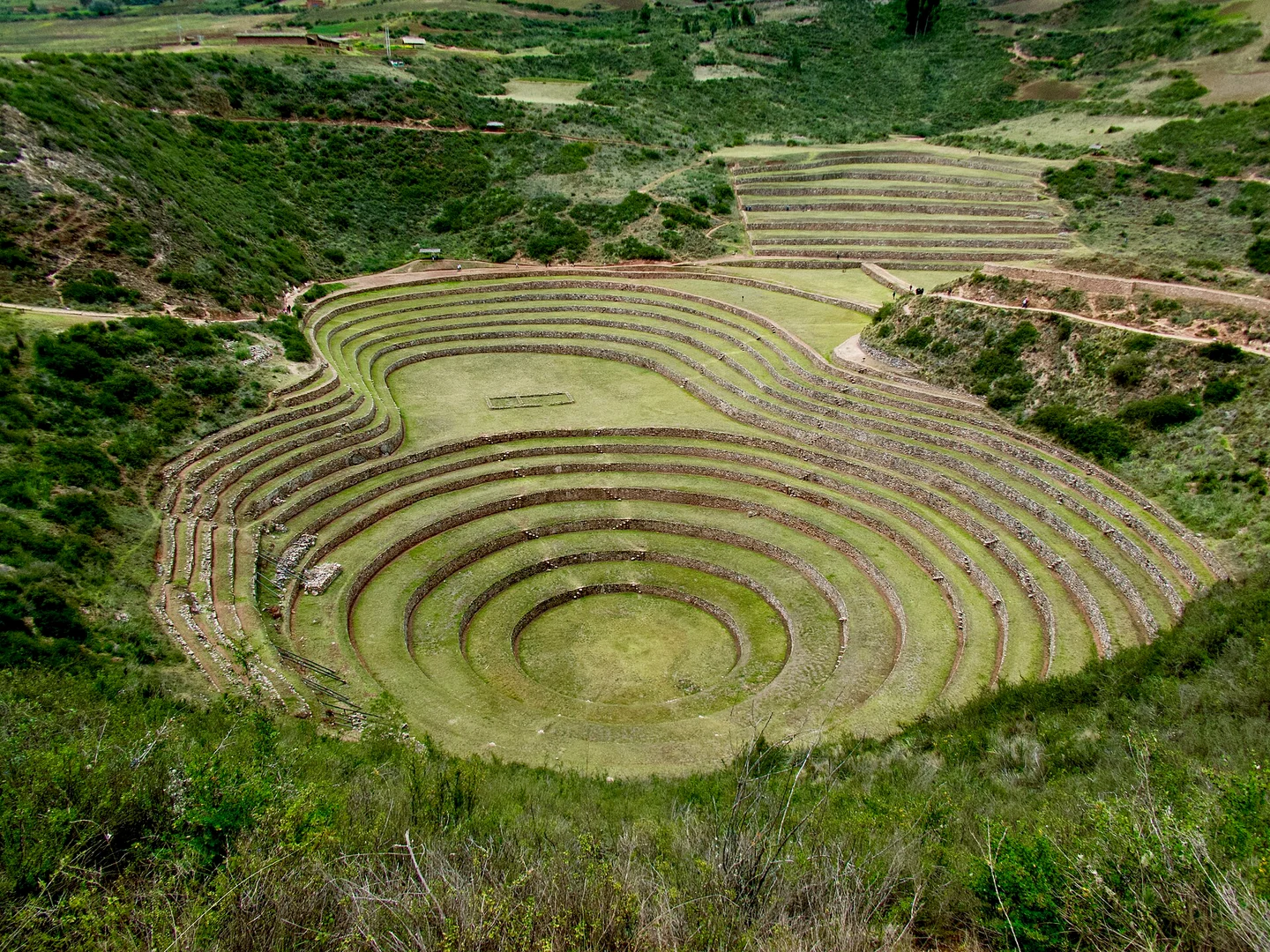

Moray draws your eyes downwards. Rings of terraces descend into a broad hollow, their stone edges set against grass and the higher landscape around them. From a distance, the pattern looks almost simple. Stay with it and questions begin to appear: why this position, why this shape, and how did people manage water in such a depression?
The complex lies in the Maras area above the Sacred Valley. Here, Inca construction is not a single building standing apart from the mountain. The ground itself has been arranged. Moray therefore makes an interesting counterpart to visits focused on temple walls, doorways or fortifications. Attention shifts from an individual stone to the organisation of a whole landscape.
More than a single circular hollow
MINCETUR describes three large, approximately circular depressions furnished with concentric terraces. Do not devote all your attention to the best-known large bowl. From the permitted visitor points, compare the position and shape of other sections you can see. A photograph can suggest one perfectly circular object, whereas the complex has more variation than that image conveys.
Start with the way terraces handle the changes in level. Stone retaining walls support them, and their arrangement relates to the existing terrain. Ask a guide how builders brought soil, stone and water together. You do not have to count every level to recognise something beyond decorative geometry. The shape is also a means of making use of space.
The tourism inventory discusses water supply and drainage, soils and differing environmental conditions. These provide useful starting points for an explanation on site. Ask which traces are actually visible and which aspects of the account come from research. A channel does not have to be spectacularly large to matter when trying to understand such a substantial bowl.
What about the agricultural laboratory?
The cultural authority describes Moray as a centre for agricultural experimentation. MINCETUR phrases the account more cautiously: the arrangement is associated with agricultural management and crop adaptation, while its specific function remains under investigation. That is not a reason to discard the explanation. It is a reason to distinguish the visible terraces from a detailed account of exactly what took place here.
Differences in depth, sun exposure and air circulation help explain interest in local environmental variation. Do not turn that into a fixed temperature difference for every ring. If a guide gives an exact figure, ask which research it comes from. You do not have to accept an entire theory before finding the engineering and landscape idea interesting.
The same applies to comparisons with an amphitheatre or an astronomical instrument. A resemblance in shape does not establish the original purpose. MINCETUR explicitly calls the astronomical-observatory interpretation a hypothesis. Keep your visit connected to the questions the ground raises: how was soil held in place, how was water handled, and what possibilities did a stepped arrangement create?
An overview without making the bottom the goal
Do not assume unrestricted access to all terraces or a descent into the centre. Ask staff to explain the current visitor circuit and follow the directions on site. Seeing people on a lower level in a photograph does not establish that your visit can take the same route. Choose a guide or transport arrangement for a clear visit plan rather than a promise to reach every part.
As an editorial planning allowance, we would reserve roughly one to one and a half hours for looking and explanations at Moray, excluding travel and admission. You may want longer for comparisons or less time for a simple view of the pattern. This is not an official circuit duration. A shorter visit can still be attentive when you have a few useful questions rather than only a photograph list.
If walking conditions matter, ask about the route from the entrance to viewpoints, surfaces and any steps. The cultural authority describes a level approach to the entry point, but that description does not establish the suitability of every possible circuit for you. Discuss particular needs using the actual route plan. A clear overview may be a better choice than a longer walk you did not really want.
Combine Moray and Maras without a checklist rush
Moray and Maras make a coherent pairing if you are interested in landscapes and their human use. In a quotation, distinguish Maras village, any salt-pan visit and Moray itself. These are not three names for the same stop. Decide which parts interest you and ask how the day divides between travel, explanations and any shops or demonstrations.
Agree on where the journey starts and ends: back in Cusco, at your valley accommodation, or at the next overnight base. For an onward day, have luggage arrangements confirmed too. A train or another fixed departure later that day calls for a shorter programme. The sites do not become smaller because there are more entries on your itinerary.
COSITUC lists Moray in Circuit III with Pisac, Ollantaytambo and Chinchero. Check whether a partial or integral boleto fits your chosen days and confirm the relevant category and documents. According to its FAQ, the ticket includes neither a guide nor transport. For combinations with other stops, have each admission itemised so that “included” has a specific meaning.
You do not need to leave Moray with one definitive explanation. Looking more attentively and distinguishing what a structure shows from what researchers infer is already worthwhile. Carry those questions into other terrace visits in the Sacred Valley. They can make the next stop more interesting without requiring every place to be another laboratory.
Places to stay in Urubamba
Compare accommodation locations in Urubamba as a base for visiting Moray.