
Áspero lies near Supe Puerto on the coast of Barranca province. It belonged to the same civilisation as Caral, but the sea gave it a different role. Marine resources were gathered and processed here and exchanged with settlements in the valley. The monumental buildings therefore belong to the same story as everyday work. Fishing helped support the economy within which these early cities developed.

A network connecting coast and valley
The Zona Arqueológica Caral dates Áspero’s development to roughly 3000–1800 BC. Its researchers describe exchange between coastal communities and farmers in the valley. Their work records cotton nets, stone weights, gourd floats and hooks made from shell. These are small objects with a larger story: knowledge of materials and fishing techniques helped people obtain, preserve and exchange food.
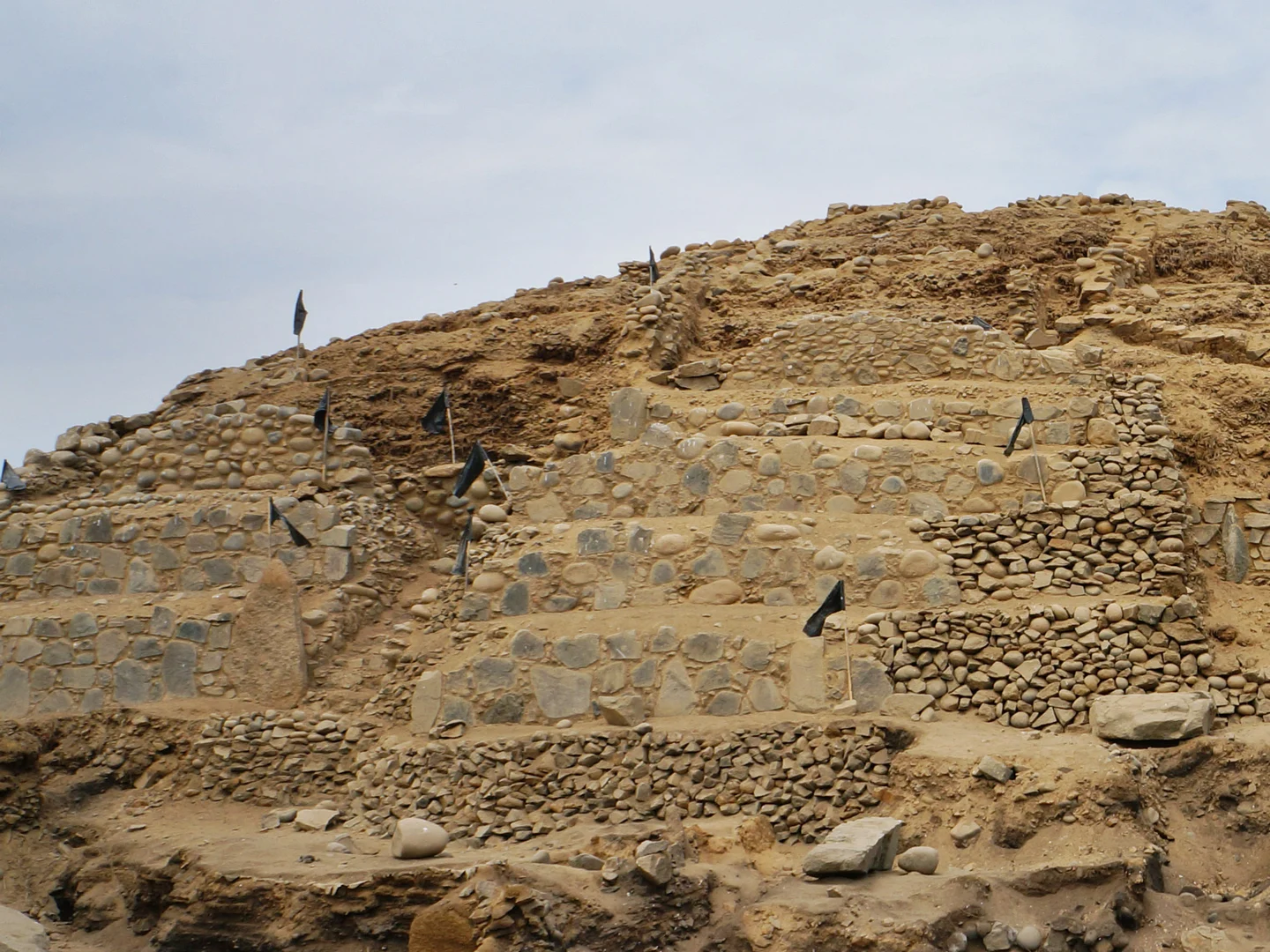
Prominent buildings include Huaca Alta, Huaca de los Ídolos and Huaca de los Sacrificios. Use their names as starting points for interpretation rather than three separate photograph stops. Ask how public buildings relate to residential and storage areas. It makes the settlement’s different functions and social relationships easier to understand, rather than seeing a collection of interchangeable pyramids. Distinguishing the site, a building and an excavated object helps too.
Interpretation before the buildings
The manager describes a visitor reception centre, an interpretation centre with displays, models and replicas, and a circuit linking monumental and residential areas. Start with the overview when it forms part of your visit. A model can reveal connections that are harder to recognise among low wall remains outside. Have the reception team identify the actual circuit; a plan of the whole settlement is not automatically the route followed that day.
Research continues to change what is known about the people who lived here. In its report on Áspero Raymi in 2025, the Zona Arqueológica Caral described renewed visitor information and research into elite burials at Huaca de los Ídolos. That offers a good question for a visit: what has recent research changed in the interpretation? An announced discovery does not establish that the original object or burial is on public display.
Because fishing matters so much here, go beyond asking how old something is. How do researchers identify the material used for a net? What does a storage area reveal about keeping food? What relationship do they see between daily work and public buildings? Those questions make the difference from Caral concrete. You are looking for the coastal side of a shared system, rather than a smaller version of the same monuments.
A visit with local interpretation
The official visiting procedure requires accompaniment by a local guide or cultural interpreter authorised by the Zona Arqueológica Caral. The same page lists a maximum of ten participants per group. Arrange that interpretation as part of the visit rather than an optional addition after arrival. The service estimates about two hours from arrival to departure. That is its usual visit indication; travel from Barranca and onward journeys require additional time.
Use Áspero’s visitor reception centre as the transport destination. The manager describes the approach through Supe Puerto from the old Panamericana Norte; the archaeological entrance is more specific than simply “Supe”. Agree whether a driver waits or returns later. Taking a bus to the region does not arrange the final stretch to reception. Leave room between arrival and archaeology rather than making both depend on one tight connection.
Áspero instead of Caral, or alongside it?
Choose Áspero to understand the coastal side of this early society. Caral adds the scale and inland setting of a major valley centre. Together they offer more than a quick look at the largest buildings at each. A stay around Barranca lets you divide your attention across separate visits. With limited time, I would explore one site properly and leave the other for another occasion rather than shortening both circuits just to collect two names.
Places to stay in Barranca
Compare the locations of places to stay in Barranca as a base for visiting Áspero.