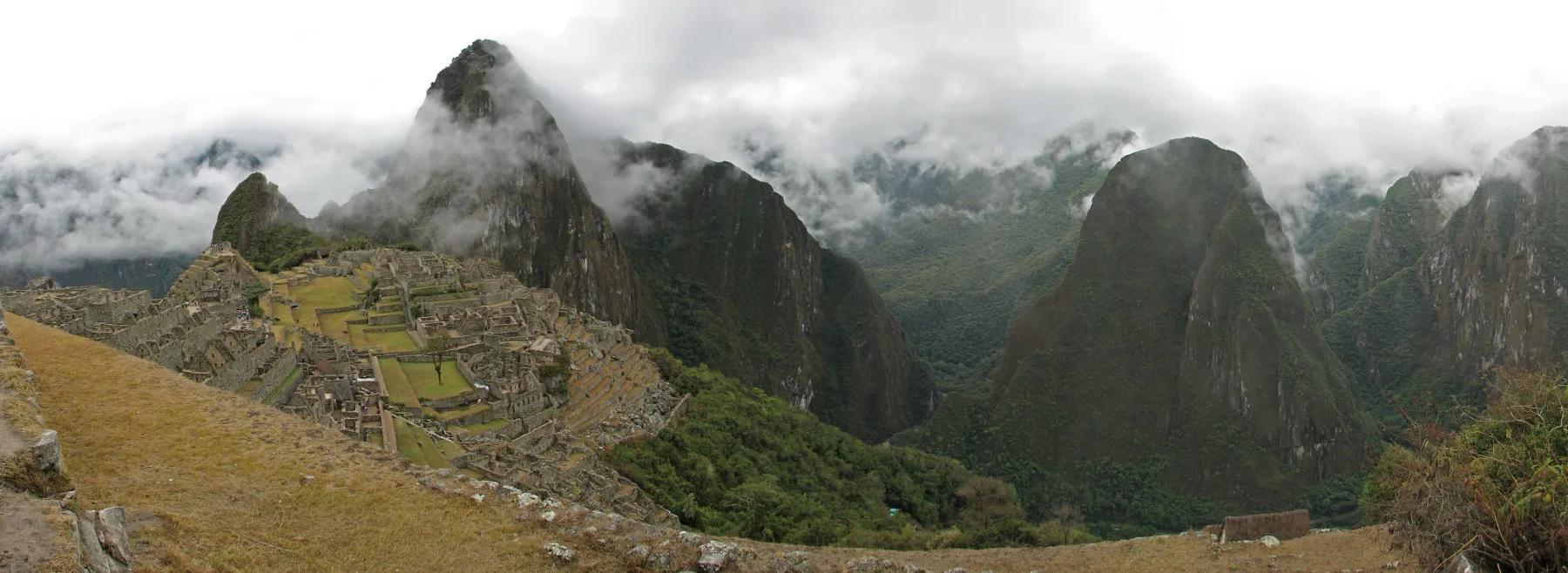
The terraces of Machu Picchu lie above Machupicchu Pueblo. Adapted sections and a viewpoint for wheelchair users have been described at Circuito 3, but your visit depends on your chosen route and the transfers before and after it. Have the route and assistance possible for your date and mobility aid confirmed in advance.

From your hotel to the Machu Picchu exit
Start with the full chain: room and bathroom, transport to your departure point, station, train, Machupicchu Pueblo, the uphill bus, the check, the circuit and the way back. First decide what you can and want to do yourself; then which mobility aid is travelling with you; only then what help a carrier or site manager has actually confirmed. A general page using the word ‘accessible’ does not replace those arrangements.
Circuit 3 is a lead, not a promise
In August 2026, CONADIS described adapted sections and an accessible viewpoint for wheelchair users at Circuito 3, also called Ruta Inclusiva. The same inspection identified improvements still needed at the ramp and main entrance. That is a reason to ask targeted questions, not to treat the whole archaeological site or the whole journey as step-free.
Always ask for the full route code on your ticket. Circuit 3 includes 3-A, 3-B, 3-C and 3-D; the inspection notice does not say which one it assessed. The 3-B map does show a symbol for motor impairment and separate entrance and exit, but no measurements for slopes, steps, surfaces, passageways, rest points or toilets. Have your exact route code, admission time and mobility aid confirmed in writing instead.
Describe your mobility aid precisely
‘I am travelling with a wheelchair’ gives a carrier too little to work with. State whether it is manual or powered, whether it folds, its dimensions and weight, and, for a battery, its type. Also say whether a transfer to a standard seat is possible and exactly what help you need. That lets an answer about a train, bus or checkpoint address your situation rather than a general idea of assistance.
Information about walking sticks is not straightforward. The current conduct page lists sticks among prohibited items, while a formal 2018 amendment permits rubber-tipped sticks for people with disabilities and older visitors. Those online sources therefore do not give one clear answer about what applies at the gate. Put the type, tip and need to the DDC in writing in advance via callcenter@culturacusco.gob.pe, and carry the response. The same conduct page does name guide dogs as an exception; even then, confirm the specific entry and assistance for your visit.
The train: request help for the right service
Inca Rail has a specific request procedure for help boarding or alighting because of a disability. Email consultas@incarail.com at least 48 hours before the scheduled service with your ticket number, journey details and the help you need. The procedure is useful because it links an answer to your journey. It does not itself establish a lift, step-free route, wheelchair space, lifting help or acceptance of every mobility aid; ask about those points separately.
PeruRail publishes specialassistance@perurail.com for Special Assistance. Use the specific train number, date, mobility aid and both outward and return journeys there as well. Its contact page does not say which stations, trains or aids are supported, and gives no advance-notice period. A reply saying only ‘we will help’ therefore calls for a follow-up: where, at which door or transfer, and what happens if that cannot be done?
Inca Rail mentions ramps in designated parts of Machupicchu Pueblo station and assistance for wheelchair users after an advance request. In Ollantaytambo, it describes two buildings opposite each other: one for tickets and luggage, one for the waiting room and station access. Neither description proves a continuous route from vehicle to seat, or from platform to street. Ask who will meet you on arrival and on the return journey, and how luggage fits into that arrangement.
The uphill bus needs its own arrangement
TRAMUSA describes on its own website the bus service between Machupicchu Pueblo and the archaeological park, but the available sources do not confirm a current ramp, lift, restraint, boarding help, queue priority or mobility-aid reservation. Discussion of at least four ramp-equipped buses in a future tender does not mean those buses run now. Ask the carrier responsible for your journey which vehicle and boarding procedure are confirmed, and what the alternative is if that arrangement fails.
Hotel and return journey belong to the same plan
Ask your chosen accommodation about its entrance, lift or floor, room and bathroom, space for the mobility aid, and the route to the vehicle or station. Look beyond arrival too: luggage travelling separately, a late train or a booked assistant can shape the return just as much as the entrance to Machu Picchu.
Make one request someone can answer
A short request works better than simply asking whether something is accessible. For example: ‘I am travelling on [date] on service [number], ticket [number], with route [code]. I use a [mobility aid, dimensions, weight] and need help with [specific action]. Can you confirm in writing who will help me where on both the outward and return journeys, whether this aid is permitted, and what the alternative is if the agreed help or vehicle is unavailable?’ For the site, add the entrance, route code and admission time.
Keep the replies offline with the name, department and date. Confirmation for a train does not automatically cover the bus, circuit or return journey. Before leaving, also agree when you will stop or turn back if a transfer is different from what was confirmed. That way, the whole day does not rely on one unclear link.
Shortly before departure: read your confirmations together
Check that the dates and time slots for hotel, transport and admission, along with the route code, fit together. Pay particular attention to the return: departure point, station, luggage and any assistance need to connect. If a specific answer is missing for an essential link, do not treat it as arranged. A different route, time slot or postponement may then be wiser than hoping a general promise will fit on the day.