
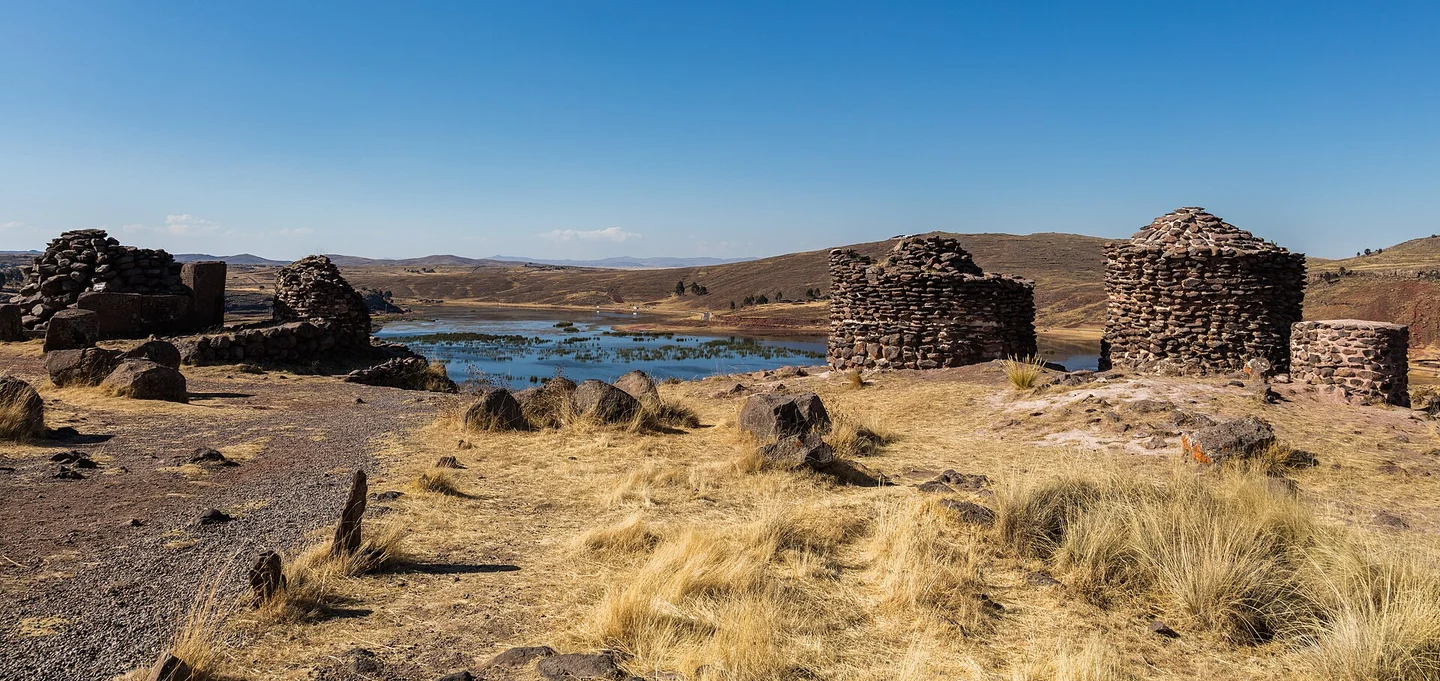

At Sillustani, stone towers stand above the water. Some look broad and heavy; others draw your eye upwards along carefully shaped outer walls. The lake and open ground give the structures room. That setting is not an incidental backdrop. This is a place where people gave their dead a lasting position in the landscape.
The water is Lake Umayo, not Titicaca. Sillustani occupies a peninsula near Atuncolla, outside Puno. It does not require an island excursion. The visit has a different rhythm and subject from a boat day. If you have thought of Puno mainly as a departure point for islands, this is a good reason to look at its mainland surroundings too.
Towers for people, not just photographs
The chullpas are funerary structures. Peru's Ministry of Culture describes them as tombs or mausoleums for people of high social status, buried with possessions. That changes the questions you can ask on site. Who received such a burial, what survives, and what does the construction reveal about the community behind it? Remembering a tower's height alone misses the human part of the story.
Sillustani does not belong exclusively to the Incas. The Colla or Qolla culture matters, and MINCETUR describes different construction forms and cultural periods. On a guided visit, ask how periods are distinguished rather than only which tower is most famous. A good answer may be qualified; a stone does not automatically reveal who placed it without further investigation.
Compare the masonry of two towers. The inventory distinguishes, among other types, carefully worked blocks and more irregular stonework joined with earth mortar. Look at block shapes, joints and the way the wall rises. Differences become visible without memorising every dynasty. Then ask how the guide interprets those differences, instead of accepting a label before you have looked.
One familiar name is the chullpa del Lagarto. MINCETUR connects it with a lizard carved on a stone block. Ask a guide to point out the decoration when it is visible from the visitor circuit. Afterwards, look at a less conspicuous structure too. The comparison prevents the entire visit from revolving around the best-known example and leaves room for details you might otherwise pass.
The lake belongs in the visit
Alternate looking at towers with taking in the site as a whole. MINCETUR describes funerary areas on the higher ground and terraces on the slopes. Ask how these elements relate. Understanding why a complex developed here is more interesting than simply moving from one monument to the next. Leave a moment to look at the landscape without an explanation as well.
Keep the original purpose in mind. Observe from the indicated visitor route and do not treat small openings or loose structural remains as invitations to crawl inside or touch them. Let staff explain which parts can be viewed. A photograph usually needs a different position more than it needs a step onto a monument.
What could a museum add?
PROMPERÚ also identifies a site museum at Sillustani with material from the Colla, Tiahuanaco and Inca cultures. A site and a collection show different things: outdoors you understand scale and position; objects can give materials, uses and provenance more attention. Separately confirm whether the museum can be visited on your date and whether it belongs within the agreed circuit and admission.
Do not add the museum merely because it appears on a list. If the site leaves you curious about objects or excavations, it may add something substantial. Ask your guide beforehand whether the visit allows time for that. Without an agreement, do not assume your outdoor circuit will automatically end with a comprehensive collection presentation.
From Puno or during an airport transfer?
As an editorial starting point, we would reserve roughly one and a half to two hours for the archaeological ground, excluding travel, ticket purchase and any museum visit. This is a choice for attentive looking, not an official duration or universal walking time. Allow longer for extensive explanations. With less time, consciously compare a few towers instead of hurrying past everything.
A dedicated excursion from Puno makes that time easier to identify in the programme. A transfer stop can work too, but first establish the actual route, waiting allowance and required arrival. Do not leave it at “Sillustani en route”. Agree what happens if the day starts late or the available time shrinks. An airport commitment does not give you extra minutes at the site.
Check current visiting hours, admission categories and any museum access with the manager. Have a provider specify who guides the visit, where the vehicle waits and how much time remains on site. The tourism inventory describes approaches and services; it does not confirm a departing bus, an available guide or a suitable connection on your date.
What you can leave out around it
If you have one free day near Puno, first decide what you want to understand. An island programme suits a wish to spend the day on the water. Sillustani is a separate choice for burial architecture, different building traditions and the Umayo landscape. You do not need to squeeze both into one day to have taken the area seriously. They answer different questions.
Take away one clear distinction between towers and one account of the people behind them rather than only a series of similar photographs. Sillustani rewards looking at a building detail and then stepping back again. The chullpas regain their setting that way: surviving parts of a funerary tradition beside a lake, rather than isolated stone objects.
Places to stay in Puno
Compare accommodation locations in Puno as a base for visiting Sillustani.