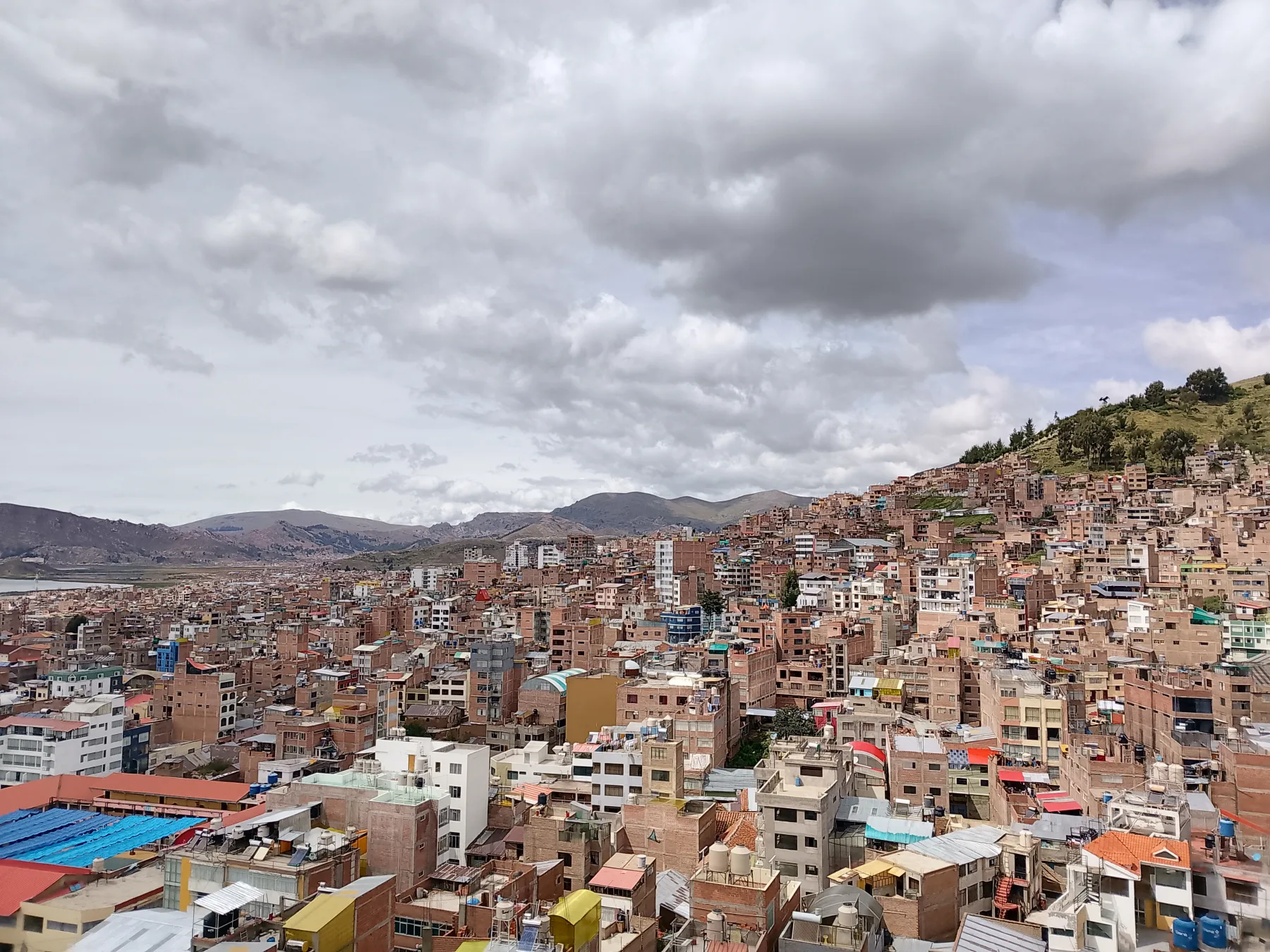
Puno faces a bay of Lake Titicaca, its houses climbing the slopes towards the high plateau. Boats wait below, while the Plaza de Armas brings together the cathedral, old townhouses and restaurants. These are two sides of the same city. From the lake you notice its size; on foot, smaller details emerge: figures carved into a church façade, a painting of boatmen, quinoa and trout on a menu.

In February, Puno turns up the volume. Music, dancing and processions fill the city during the Virgen de la Candelaria celebrations. At other times, the sanctuary and museum offer a way into that culture. There is plenty here for a city day between arriving and setting off across the lake.
Pause in front of the cathedral
The cathedral stands on the west side of the Plaza de Armas. Flowers, birds and other animals appear between the twisted columns of its granite façade. Catholic Baroque imagery incorporates Andean motifs here. Stand back to see the overall composition, then move closer to the carving: there is quite a lot happening above that door.
Carlos Dreyer: the lake in paintings and archaeology
Museo Municipal Carlos Dreyer is close to the square, in the German painter and collector's former family home. Its collection combines archaeological objects with paintings. A particular connection is Sillustani: gold ornaments and burial finds from that site are displayed here. The collection also includes mummies.
Make room for both the art and archaeology. Balseros, a painting of boatmen, places people in the landscape you may just have seen from the water. The Sillustani objects then provide a reason to visit the burial towers outside the city. The two visits fit together particularly well.
From Parque Pino to Candelaria
San Juan Bautista, the sanctuary of the Virgen de la Candelaria, stands by Parque Pino. February's celebrations combine Catholic traditions with Quechua and Aymara worldviews. Musicians, dancers and mask-makers pass on their skills through rehearsals and workshops. Much of the festival takes shape long before it reaches the streets.
Walk from the Plaza de Armas to Parque Pino to include the sanctuary in your city visit. If the festival is your reason for coming, use the programme for your travel year to choose your dates. A procession, a dance competition and an ordinary church visit offer different experiences.
Quinoa on the table, coffee from Sandia
Pesque is a soft quinoa dish made with milk and cheese. Chairo is heartier: a soup with lamb, dried meat, vegetables, potato and chuño, freeze-dried potato. Both offer something beyond the trout that frequently appears on menus. Start with a soup, perhaps, and see how hungry you are afterwards.
Mojsa occupies an upper floor overlooking the Plaza de Armas, on Jr. Lima. Its own menu includes quinoa soup, trout, alpaca-ragù ravioli and vegetarian cannelloni, making it useful for a group with different appetites. The restaurant also lists coffee from Alto Inambari in Sandia province: Puno's region reaches beyond the high plateau surrounding the city.
Above the city and beside the water
Huajsapata lies west of the centre and has a statue of Manco Cápac. Its view brings the city and lake together. Kuntur Wasi is another viewpoint, reached by a long staircase. Choose one if you fancy an uphill addition to your city walk; the waterfront offers a different, lower perspective.
Bahía de los Incas has a lakeside promenade. Here the focus shifts from façades to the bay. You could combine the walk with finding the harbour for the following day's outing, but confirm your actual departure point: a lakeside stay may use a different pier.
A day in Puno
Start with the cathedral and Dreyer museum. Take time for lunch, then walk to Parque Pino. Follow that with Huajsapata or the promenade, depending on what appeals. Sillustani adds a separate drive outside the city; it works better as its own outing than squeezed between city sights.
Stay in the centre or by the lake?
Around the Plaza de Armas you are well placed for restaurants and these city visits. A waterfront hotel may offer lake views without being within walking distance of the centre. Compare the locations of your hotel, pier and bus departure before booking. If flying, Juliaca is the arrival point for the onward road journey to Puno.
If you will spend the next night on Amantaní, ask your hotel whether you can leave larger bags behind. Keep the island night and your return to Puno clear when booking rooms. It is reassuring to know where both your luggage and your bed will be after the boat trip.
Places to stay in Puno
Compare the locations of places to stay in and around Puno.
Where is it?
Puno and the surrounding area.