
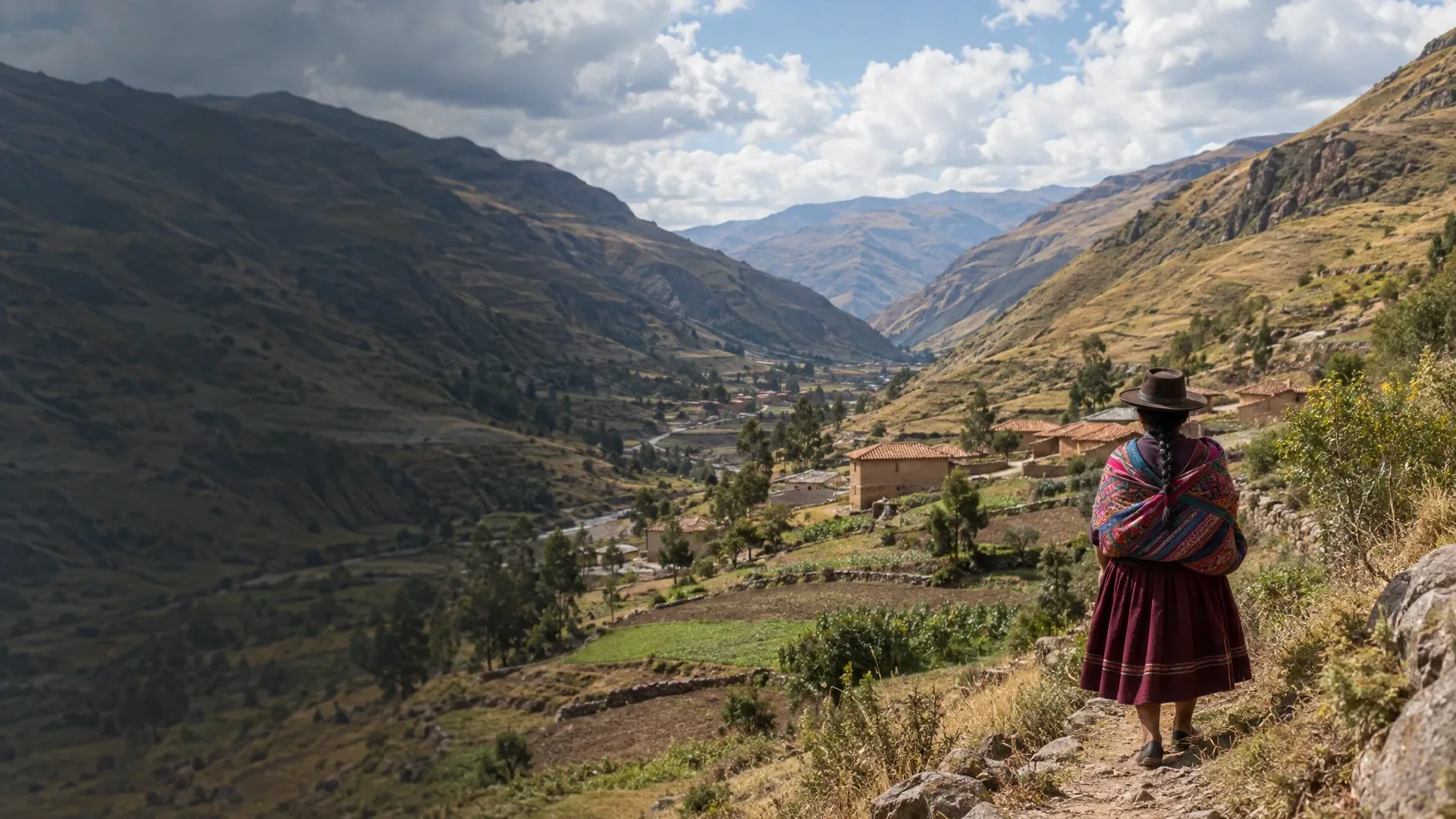
A painted wooden box can hold an entire scene, with musicians, animals and people at work. In Quinua, small pottery churches stand on tiled roofs. Elsewhere, the stones of Wari and Vilcashuamán take up the story. Huancavelica has white cathedral towers, a red carved façade and the remains of a mining landscape. This region brings crafts, towns and different periods of Andean history together.
Ayacucho and Quinua: retablos and ceramics
Ayacucho’s retablos are wooden boxes holding modelled and painted figures. Alongside religious subjects came scenes of everyday life, a development in which Joaquín López Antay played an important role. Look at the arrangement of a scene and the work in each small figure. The Ayacucho town and craft guide explores this further.
Quinua has cobbled streets, tiled roofs and a pottery tradition of its own. Churches, musicians, bulls and useful household objects are among the pieces made here. The inventory describes workshops within homes; arrange who will receive you for a particular visit. Give the village and its crafts time of their own, even if you also want to stop at Wari on the way.
Wari and Vilcashuamán: from the Wari to the Incas
Wari was an urban capital before the Incas. Walls, passages and courtyards belong to a much larger complex, while its museum adds excavated pottery, textiles and stonework. Its position on the road to Quinua makes a combination possible, with separate time for the museum and chosen outdoor sections.
Vilcashuamán, by contrast, has Inca architecture. Its ushnu consists of five stacked stone platforms, with steps and a trapezoidal entrance. The raised position was associated with gatherings in the large open space. Give this town a different travel day from Wari and Quinua.
A day at the Millpu pools
Near Circamarca the river runs through a gorge with blue-green pools. Millpu is further from the city than Wari and Quinua. Give it a day of its own if you want to see the country south of Ayacucho after visiting the archaeological sites. Millpu: Ayacucho’s turquoise pools
Huancavelica: a town square and a mining landscape
At Huancavelica’s Plaza de Armas, the cathedral’s red carved façade contrasts with its white towers. Roofs, porticoes and mountains surround the square. The town has a distinctive starting point of its own, alongside the mining history of Santa Bárbara.
Santa Bárbara involved mercury extraction, processing, storage and transport. Alongside mine entrances, the heritage inventory describes homes, religious and public buildings, furnaces and remains of transport installations. This wider landscape helps explain the growth of settlements and trade. For a visit, agree which above-ground areas are accessible and who will receive you.
Give Huancavelica its own stage
The five-day Ayacucho route connects the city with Quinua and Vilcashuamán. Wari is a possible stop towards Quinua. Huancavelica is outside those five days: arrange its arrival, departure and overnight stays separately. For a short stop, choose Ayacucho with one outing, and work out onward journeys before adding more towns.
Ayacucho as a stop on the way to Cusco
Can this be a short stop on the way to Cusco?
Choose Ayacucho and one excursion in that case. Quinua, Vilcashuamán and Huancavelica together need a different pace; they are not stops along one through journey.