
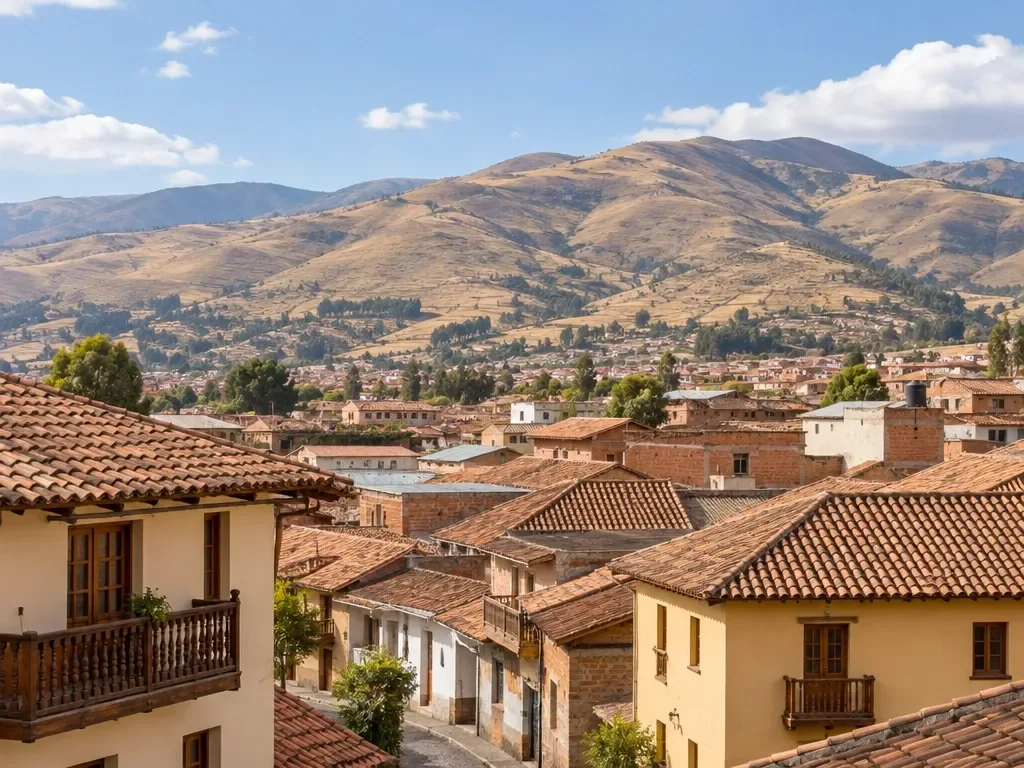
Stone arches around a square, wooden balconies above them and clay-tiled roofs: Plaza Mayor gives Ayacucho a distinctive centre. Sucre’s equestrian monument stands in the middle, with the cathedral, public buildings and arcades around the edges. This is the centre of an inhabited city, where religious buildings, civic life and craft traditions all have a place.
Four portales around Plaza Mayor
Each side has a name: Unión, Constitución, Independencia and Municipal. Beneath these portales, stone columns and arches follow one another; above them, the materials change to wooden balconies and tiled roofs. Those different elements reward a closer look as you walk through the centre. The cathedral is also on the edge of the square.
Retablos: painted figures in a wooden box
A retablo is a wooden cabinet in which painted figures form a scene. Flowers on the doors and the tiny figures’ gestures each draw attention. The tradition has religious roots: earlier cajones, or devotional boxes, held saints and scenes associated with livestock and its protection. Celebrations, work and other aspects of daily life later became subjects too. Joaquín López Antay played an important part in that development.
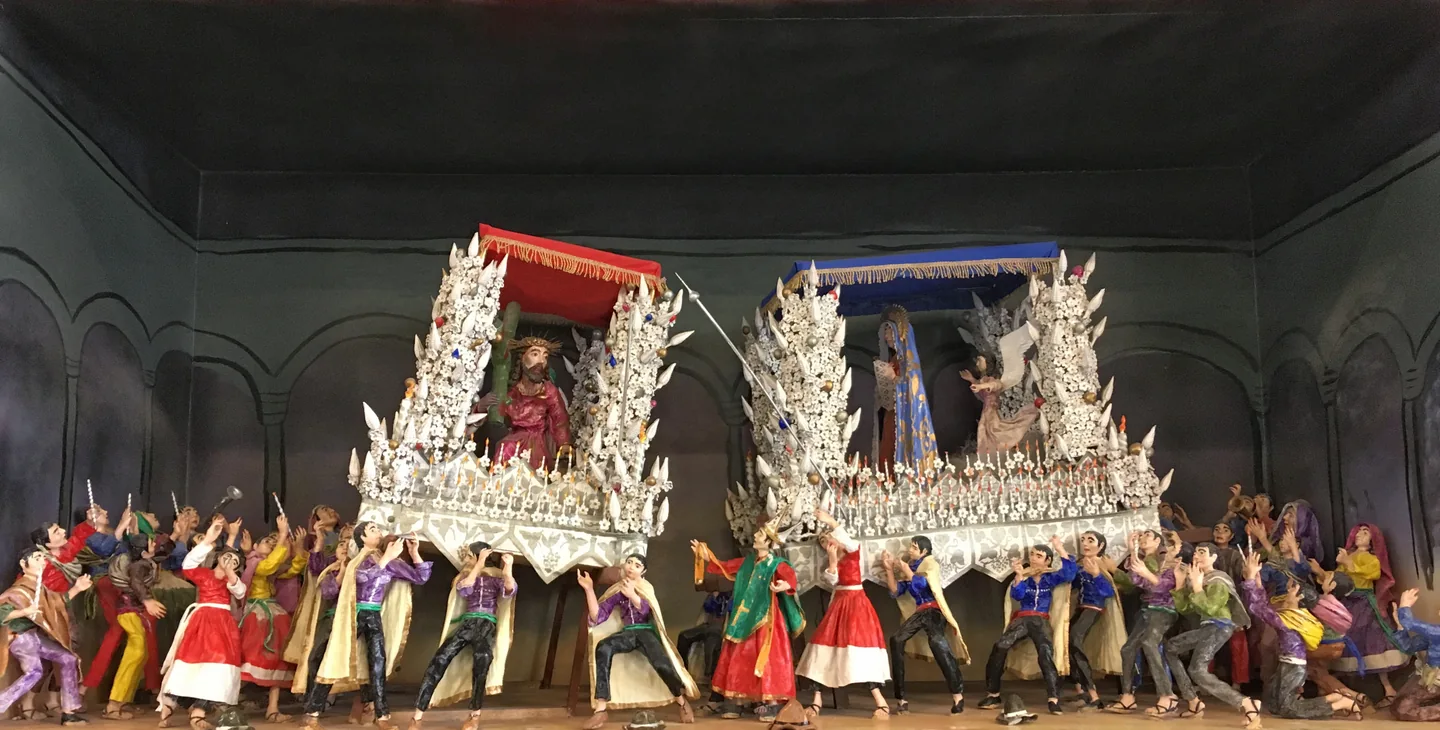
Photo credits

Full frame retained, image orientation applied, resized and converted to WebP. No image content generated or reconstructed. Derivatives retain CC BY-SA 2.0.
The cabinet and figures are worked on separately. The box receives a pale base coat and painted decoration; the little figures are shaped from paste, dried, finished and coloured before being fixed in place. Materials and methods vary between makers. If you are considering a piece, ask the seller or maker how the scene was put together and how the figures were made.
Textiles and stone belong here too
Retablos are one part of a wider craft culture. Tapestry, embroidery, pottery and Huamanga stone carving also belong to Ayacucho. UNESCO included the city in its Creative Cities Network for Crafts and Folk Art. The recognition concerns these craft and folk-art traditions.
Where to see retablos in Ayacucho
Joaquín López Antay lived and worked a few streets from Plaza Mayor. His former home on jirón Cusco displays retablos and old family photographs, alongside his workshop. Notice how the maker placed the figures inside the box. Their gestures often tell you who’s working and who’s celebrating.
Then head uphill to Santa Ana, a neighbourhood of narrow cobbled streets. It also has workshops for textiles and Huamanga stone. If you’d like to see two different crafts, follow the house museum with a visit to a weaver or stone carver. Ask in advance if you can watch someone at work.
Time in town before an outing
Two nights can leave room for arrival and a city day. Compare accommodation locations with Plaza Mayor and the places you want to visit. Wari and Quinua lie in a different visiting direction from Vilcashuamán. Wari’s site museum provides context for the excavations through pottery, textiles, stone objects and explanations. Include it if that interests you; it need not become an automatic stop on every outing.
Churches during your city visit
Do I have to visit every church?
No. Choose a few places that interest you and alternate them with crafts and food. A list of churches is not a compulsory programme.
Places to stay in Ayacucho
Compare the locations of places to stay in and around Ayacucho.
Where is it?
Ayacucho and the surrounding area.