
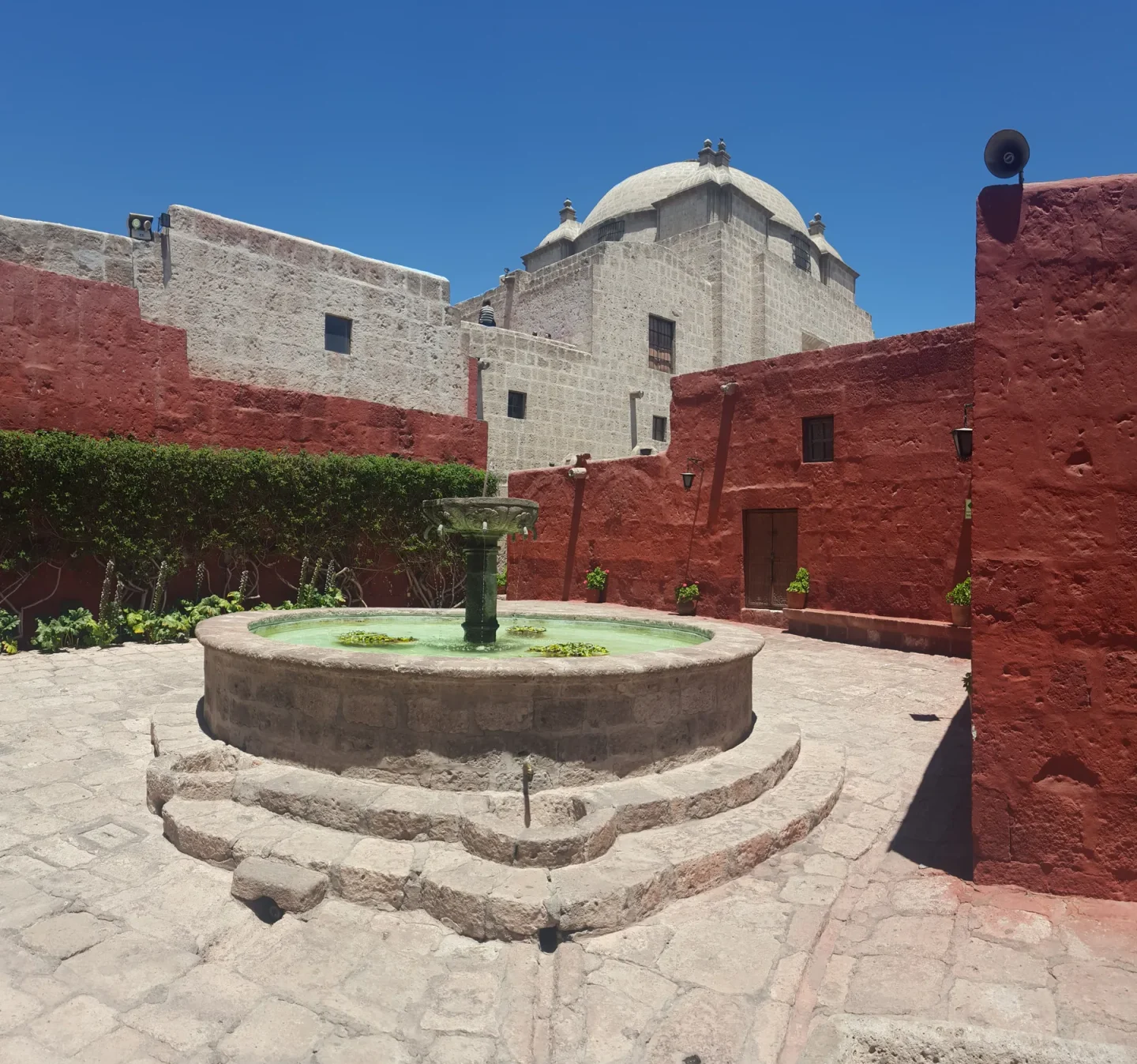

Behind Santa Catalina's walls are lanes, passages and courtyards. One space opens to the sky; the next draws you towards a doorway or a shaded gallery. Blue, red and white give the architecture its rhythm. The strongest reason to keep looking, though, lies beyond the colours: this was a place where people lived, worked, ate and prayed.
The complex belongs to historic Arequipa but has an interior world of its own. The comparison with a small town helps describe it. Do not expect one church room and a quick circuit before leaving. Streets, cells, cloisters and shared rooms create enough variety for a visit that can take an important part of your city day.
A monastery shaped over centuries
Santa Catalina was founded in 1579. Its own history connects the foundation with María de Guzmán. UNESCO describes the monastery as a religious citadel combining architecture from the sixteenth to nineteenth centuries within Arequipa's historic centre. That helps avoid imagining that everything you see was built simultaneously to one unchanging plan.
Look at the sillar, the volcanic stone important to Arequipa's architecture. UNESCO highlights the meeting of European and indigenous building traditions in the city. Compare substantial walls with arches, vaults and open spaces. You need not identify every building phase to notice the relationship between construction, light and use.
The manager states that religious life continues within Santa Catalina. The historic visitor complex is therefore not an invitation to enter every space behind the walls. Keep to the visitor route and follow staff directions about where you can look. Thinking of an inhabited religious place makes the distinction between the public circuit and other areas more meaningful.
Look beyond the blue gallery
The monastery's visitor map starts with rooms including the Locutorio and Sala de Labores and the Patio del Silencio before continuing through different cloisters. Use the sequence for orientation, not as a list to finish quickly. At the Claustro de los Naranjos, for example, choose one overview and one detail. Alternating an open court with smaller rooms already reveals something about the complex's rhythm.
Along the internal streets, do more than follow the next colour. Names including Málaga, Córdoba, Toledo and Sevilla appear on the visitor map, but their relationship with living quarters is worth examining. Where does the scale of a door or courtyard change? Which space resembles a separate house? The lanes then become more than attractive backgrounds for portraits.
Choose a feature of everyday life next: the laundry, refectory or Gran Cocina, all identified on the monastery's map. The manager describes the large kitchen as a space originally used for the first chapel. One change in use can reveal more than a string of construction dates. Ask how people adapted the same building for different purposes over time.
The Pinacoteca adds another way of looking. According to the manager, it occupies the former communal dormitory. Keep some attention for the paintings if they interest you, rather than discovering near the exit that your time is gone. If architecture and daily life matter more, give those subjects priority. Every museum element does not need an equally lengthy examination.
Independent visit, guide or evening programme?
The manager suggests approximately one hour with a guide or one and a half to two hours independently. Treat this as its estimate, not a compulsory duration or a guarantee for your pace. A guide can connect living arrangements, faith and architecture. An independent visit leaves more room to return to a courtyard or linger. Choose for the experience, not merely which format finishes fastest.
According to the monastery's information, visitors hire professional guides directly at the entrance. Guiding is optional and not included in admission; its price and arrangements depend on language, duration and group size. Agree the language, content, duration and payment beforehand. A website listing several languages does not confirm that a guide in yours will be waiting at any chosen time.
Distinguish ordinary evening opening from a theatrical visit. The manager separately describes visitas teatralizadas with historical characters and guiding within a special programme. That is a different choice from independently exploring later in the day. Ask which visit product is actually offered on your date, in what language and with which booking arrangements. A programme description does not confirm a place.
Give the monastery room in your city day
Our editorial choice would be to leave roughly half a city day around the visit, including getting there, admission arrangements and a break afterwards. That does not mean you need to spend additional hours inside. It mainly prevents watching the clock because a transfer to Chivay or another long excursion is due straight afterwards.
Check Santa Catalina's visiting hours and final admission for your date; the manager distinguishes regular hours, extended hours and closure dates. Read the admission categories alongside their document requirements, and have the manager resolve any reduced-rate questions. A category on a website is not an individual assurance. Check which elements a package actually includes too.
For particular walking or support requirements, ask about the selected route through streets, thresholds and rooms, and discuss what can be shortened. “A town within a town” says nothing about every passage or your needs. With children, you could narrow the subject: find one street, one courtyard and one room where residents gathered. That is a looking activity, not a suitability assessment for every child.
Follow Santa Catalina with a meal and time in central Arequipa. Another interior can wait for a different day. If you leave remembering a change in use or a detail of life behind the walls as well as the colours, the monastery has offered more than a good series of photographs.
Places to stay in Arequipa
Compare accommodation locations in Arequipa as a base for visiting Santa Catalina.