
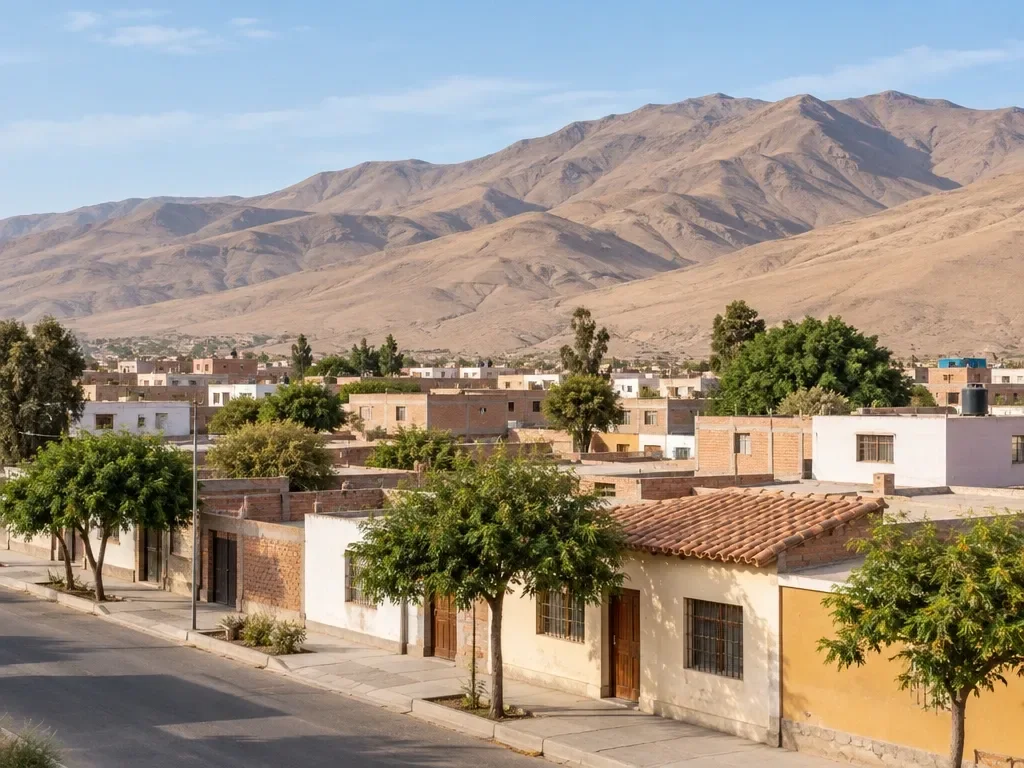
In central Tacna, the cathedral, an ornamental fountain and the Arco Parabólico come together around Paseo Cívico. The pink stone used in the buildings and monument gives the setting a recognisable coherence. Bronze figures beside the arch belong to the remembrance of the War of the Pacific. Farther outside the city, Miculla and Alto de la Alianza lead to two very different parts of the past.
The cathedral and Arco Parabólico
The cathedral was built with pink limestone from the Tacna area. Its symmetrical front and large central dome form part of the neo-Renaissance design. The Monumento a los Héroes arch stands within the same urban ensemble. Figures of Admiral Miguel Grau and Colonel Francisco Bolognesi stand on either side, facing the cathedral.
The Pileta Ornamental also stands in the square. This cast-iron fountain has stood here since 1869. Look above the largest basin for the figures of children wearing laurel wreaths. The fountain was once part of the city’s water network.
The arch and its figures are a memorial. The people and symbols refer to the war with Chile. Seeing this city monument and visiting the battlefield outside Tacna are separate parts of a stay.
Miculla: images in the stones
Miculla has stones bearing engraved images. The regional research announcement describes snakes, birds and camelids among the motifs. An interest in rock art takes you towards a different subject from the city memorial: old representations and the archaeological setting in which they were found. During a visit, ask which motifs you are looking at and how they are interpreted.
Alto de la Alianza: a place of remembrance
On 26 May 1880, Peruvian and Bolivian forces fought the Chilean army at Alto de la Alianza. The later memorial complex stands in the desert-hill landscape of the battle. It consists of the monument, a site museum and a camposanto, or cemetery. Obelisks, sculptures and crosses make the commemoration visible.
The museum description includes uniforms, weapons, letters and a model of the battle. This offers different historical context from the images on Miculla’s rocks. Choose according to your interests and establish which parts of the complex you can visit on your day, particularly if the museum is your main reason for going.
Two nights in Tacna
With two nights, you can set aside one day for an outing beyond Tacna. Depending on transport, arrival afternoon or time before departure can be used for the centre. Compare accommodation locations with Paseo Cívico and your agreed collection point. Leave time to eat in town too.
More than a place to pass through
Is Tacna only a border stop?
No. The centre, Miculla and Campo de la Alianza each offer a reason to stay. Continuing to Chile needs a separate plan; this city itinerary does not cover border formalities.
Places to stay in Tacna
Compare the locations of places to stay in and around Tacna.
Where is it?
Tacna and the surrounding area.