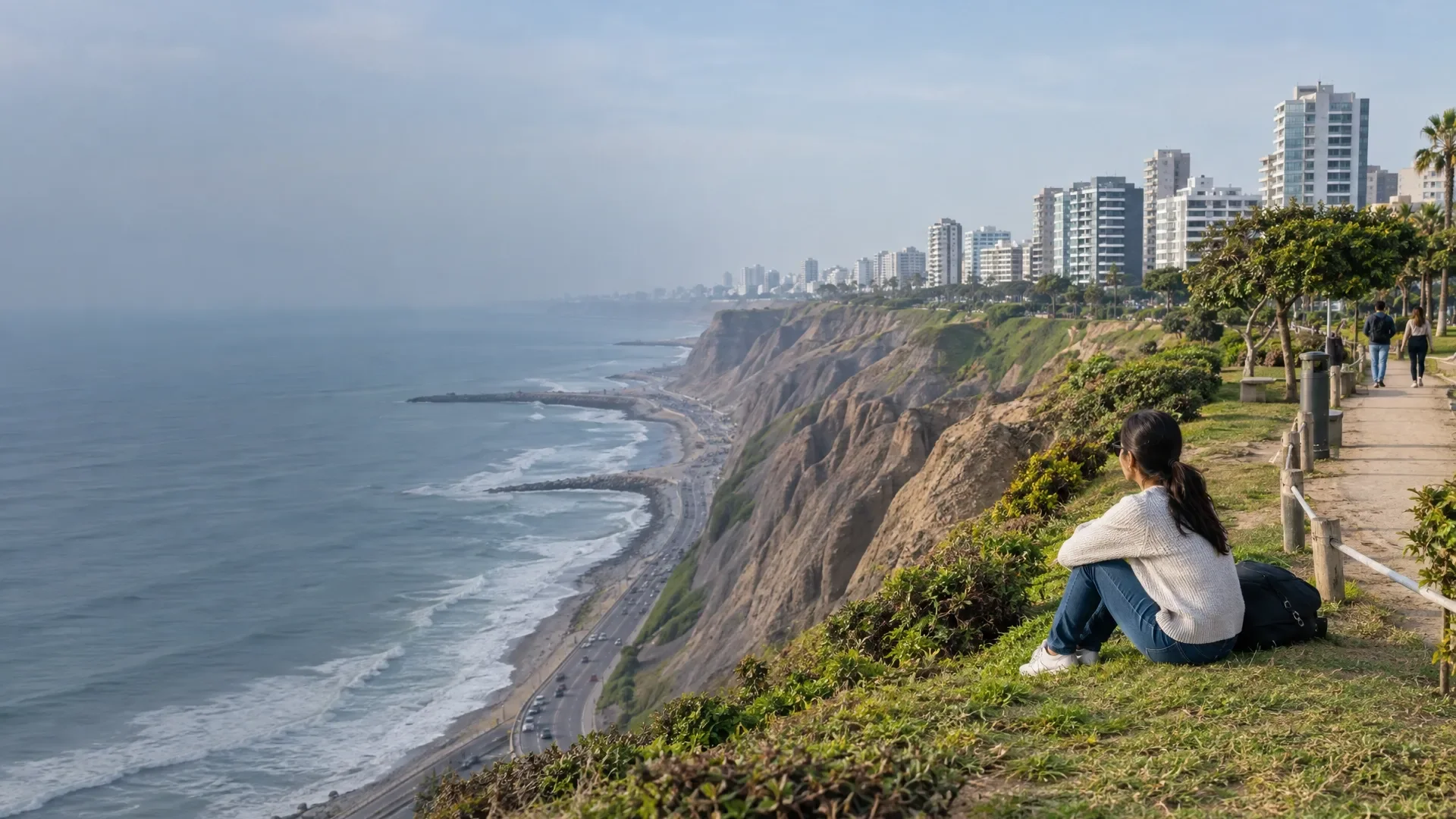
Lima stretches along the Pacific, but the city does not sit with its feet in the sand. In Miraflores and Barranco, everyday life happens on top of the cliffs; below are the coastal road and beaches, linked to the upper city by parks, bridges and descents. It creates a peculiar cityscape: towers and traffic on one side, an open horizon on the other.
Move inland and the layers change. Huaca Pucllana, an adobe archaeological site older than the colonial street grid, rises among residential blocks in Miraflores. In the historic centre, you find squares, churches, convents and enclosed wooden balconies. Anyone who treats Lima solely as the road between airport and hotel is passing through a city where several Peruvian histories remain visibly side by side.
Then there is the table. Ceviche and tiradito belong to the coast, anticuchos carry Afro-Peruvian history, and chifa grew from Chinese influence on the city. A rewarding day in Lima need not culminate at the final monument. Lunch can be the main event, with a museum or walk arranged around it.
A city understood one layer at a time
The historic centre preserves the street plan and major religious and civic ensembles of the viceregal capital. Earthquakes repeatedly forced builders to adapt; UNESCO describes adobe and brick at ground level with lighter quincha on upper floors. Lima is not old simply because a façade looks old. You are also seeing how the city learned to live with its own ground.
Huaca Pucllana interrupts the idea that Lima's history began with the Spanish foundation. Its site museum combines a small exhibition with a circuit through the archaeological zone and material from excavations conducted since 1981. It works particularly well if you want some grounding in the central coast before the rest of your trip becomes dominated by talk of the Inca.
Four areas, four kinds of visit
Miraflores, Barranco, Pueblo Libre and the historic centre are not stops on one neat walking route. They are spread across the city and reward different kinds of attention: coast and parks, streets and art, archaeology or a museum collection. Fix one area or major visit first. Only then decide whether a second will fit — Lima adds journey time without politely writing it into your itinerary.
Historic centre: look at the city before going inside
Start around Plaza Mayor. The cathedral, archbishop's palace and government palace reveal how authority and religion were organised around the same square. Then walk towards San Francisco, looking for enclosed wooden balconies, passageways and courtyards along the way. That gives you a coherent view of the centre even if you choose only one interior.
San Francisco is a logical choice for that indoor visit. Its museum is not only about the catacombs: the convent rooms, religious art and library also convey the Franciscans' long presence in Lima. The catacombs contain human remains. They are not a thrilling add-on for every group; prepare children for what they will see, or choose another interior if the subject is not right for you.
Huaca Pucllana: adobe among the apartments
Huaca Pucllana places an archaeological circuit in the middle of Miraflores. That urban setting is precisely what makes it interesting: the huaca is not a distant ruin but a place where research, conservation and a modern district meet. Do not treat the objects in the exhibition room as a prelude; they give meaning to the adobe structures outside.
Choose a daytime or evening visit according to what you want to see and how much walking suits you, then confirm the current visitor format with the museum. A restaurant view of the huaca is not the same thing as admission to the archaeological circuit. One does not replace the other.
Museo Larco: pre-Inca Peru in one narrative
Museo Larco in Pueblo Libre is a good choice if you want one broad archaeological collection. Its permanent exhibition follows ancient Peru across several cultures and periods; the visit can also include visible storage and a separate gallery of erotic ceramics. That last room attracts attention, but the connections make the visit valuable: materials, power, ritual, bodies and daily life all belong to one story.
The museum is not in Miraflores or the historic centre, so make it a deliberate visit. Check the entrance on Calle Navarra rather than relying only on the main Avenida Simón Bolívar address. If you are visiting with children, the museum map helps you decide in advance which galleries you do or do not want to include.
The malecón: Lima above the ocean
Miraflores' malecón is not one boulevard but a chain of parks along the cliffs. Parque del Amor, with its mosaic walls and Víctor Delfín's El Beso, provides a clear landmark; Parque Raimondi and the other coastal parks let you choose a short or long section. The views are from above. Reaching the beach also means planning a descent and the climb or ride back.
Barranco: do not let the bridge become the whole visit
The best-known part of Barranco clusters around Parque Municipal, Puente de los Suspiros and Bajada de Baños. The district becomes more rewarding when you include its old houses, small squares, galleries and streets towards Paseo Sáenz Peña. The bridge then becomes a hinge in a walk, not an assignment followed by one photograph and a taxi.
Restaurants, cafés, bars and venues allow afternoon to slip easily into evening in Barranco. That is an advantage if atmosphere is the point. If you want a quiet room, check the exact street, windows and neighbouring nightlife; 'staying in Barranco' says very little about how well you will sleep.
Food is not the interval
Lima's cooking reflects Indigenous, Spanish, African and Chinese influences. You do not need an expensive tasting menu to see that. A cevichería, chifa, market or unassuming comida criolla restaurant offers a different taste of the city. Give at least one meal proper time and choose by dish and district.
- Ceviche or tiradito: ceviche serves pieces of fish with citrus and seasonings; tiradito usually uses thin slices, a sauce and no onion. Ask which fish is being used that day.
- Anticuchos: grilled skewers, traditionally often made with beef heart, connected to the Afro-Peruvian influence on Lima's food.
- Causa limeña: seasoned potato assembled in layers or a roll, with fillings that vary from kitchen to kitchen.
- Chifa: Peruvian-Chinese food culture, including arroz chaufa, which brings fried rice together with Peruvian ingredients.
- Picarones are fried rings served with syrup, mazamorra morada is a thick purple-corn dessert, and suspiro a la limeña combines sweet milk custard with meringue.
Reserve when the restaurant itself advises it, but do not build your entire picture of Lima around rankings. For a spontaneous lunch, choose by dish, district and that day's opening. At markets and small restaurants, a concrete question is more useful than a star list: what is being cooked now, how large is the portion, and what went into the stock or sauce?
Where should you stay without moving every day?
Miraflores is practical for a first stay because it combines accommodation, restaurants, parks and coastal walks. Barranco is a better fit when you want galleries, smaller streets and evening life on your doorstep. San Isidro may work for a quieter or business-oriented location, but check how far it is from what you actually plan to visit. For many itineraries, the historic centre works better as a focused outing than as the base for every night.
In every district, inspect the exact street. An accommodation description that mentions the ocean may still leave you a substantial walk from a park or descent. After a late flight, also ask about reception, luggage and when you can genuinely enter the room. Your first night is a poor time for a neighbourhood-name treasure hunt with suitcases.
What fits into one or two full days?
With one full day, choose one major historical visit and one district where you will also eat. That might mean the historic centre and San Francisco followed by a deliberate lunch, or Huaca Pucllana with a long coastal walk and Barranco. A museum-focused day can pair Museo Larco with Pueblo Libre and one coastal district later, provided the transfer does not swallow half the day.
Two full days let Lima change character: one for the historic centre and a museum, another for pre-Columbian Miraflores, the cliffs and Barranco. Treat these as building blocks, not a timetable. If you arrive exhausted or leave early, do not quietly count that date as a full city day.
Distances, admission and a plan B
Plan transport for each leg and time of day. The airport is in Callao; Miraflores, Barranco, Pueblo Libre and the historic centre then lie in different directions. Check with your accommodation and the airport's official information which arrival option fits your flight, luggage and party. Do not book a tight museum slot immediately after an unpredictable cross-city journey.
Museums and archaeological sites have their own visitor formats, closed days and sometimes separate daytime and evening circuits. Confirm them with the venue. Street access and demonstrations in the historic centre can also change; choose a clear start and finish, and seek same-day local guidance about diversions when conditions warrant it.
Places to stay in Lima
Compare the locations of places to stay in and around Lima.
Where is it?
Lima and the surrounding area.