
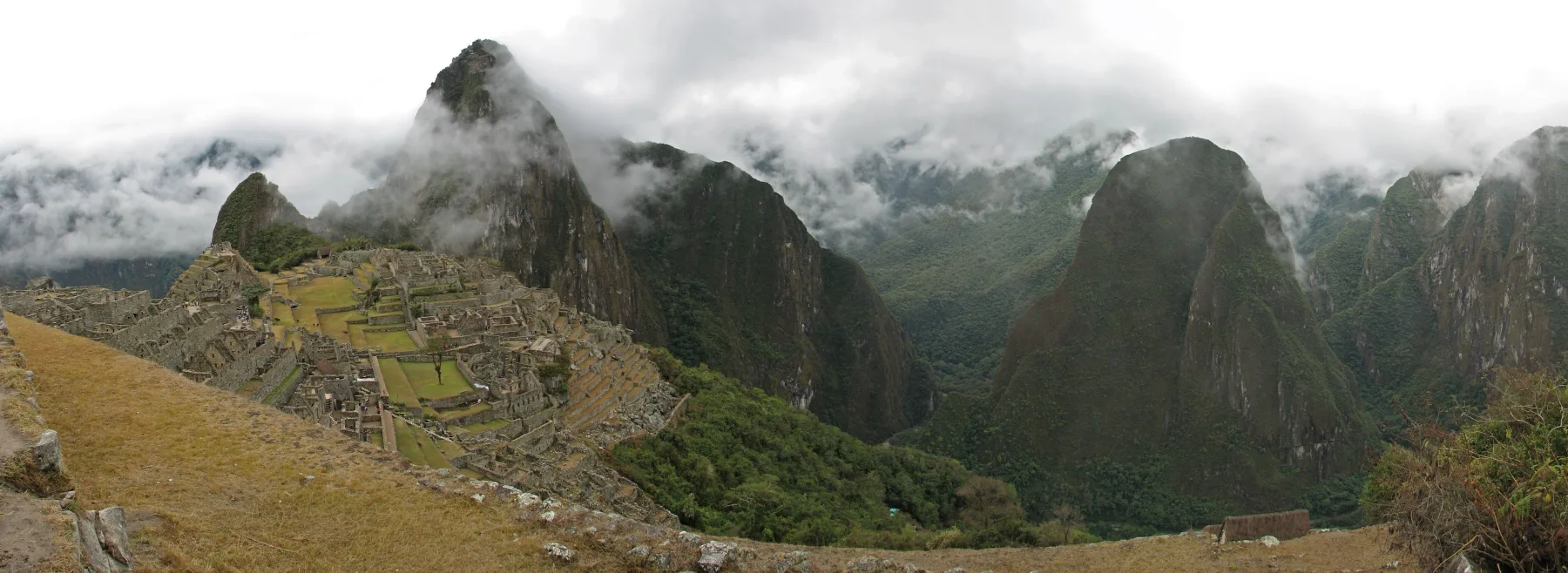

For a first visit combining the setting of Machu Picchu with its buildings, start with circuit 2. Circuit 1 focuses on views from the upper terraces; circuit 3 covers lower buildings and offers routes towards Waynapicchu. Then choose the exact route code, date and admission time. Those details give you a basis for choosing a train and somewhere to stay.
One circuit, several routes
The official system has three circuits and ten routes. The number identifies the circuit and the letter its variant: 1B and 3B are different visits. A booking described simply as ‘Machu Picchu’ leaves out an important detail. Look for the full route code and name. A mountain walk shown on the same map is not automatically included in your route.
Circuit 2: terraces and the town
Machupicchu Clásico leads from the agricultural sector into the built-up area. The official maps name Caos Granítico, Plaza de los Templos, Roca Sagrada and Espejos de Agua among its features. You see the town in its landscape before walking among its walls. This makes the circuit a useful starting point if exploring the archaeological site is your priority.
2A is called Ruta diseñada; 2B is Terraza Inferior. The official maps show different approaches: 2B passes the Plataforma Inferior. The routes then share much of their passage through the town. If you are choosing between them, compare that opening section on the two maps. The name of 2B does not mean you stay exclusively at the bottom of the town, nor is it the Terraza Superior of 1B. Compare 2A and 2B on the official circuit map.

Circuit 1: the town among the mountains
Panorámico focuses on the upper terraces and views across the town and surrounding mountains. Route 1B, Terraza Superior, stays within that terrace section. You look over the buildings without following circuit 2 through the town. It is an appealing option if you want to spend time taking in the landscape; a visit centred on seeing temples and buildings up close is a different choice.
The other circuit 1 routes add a walking destination: 1A goes to Montaña Machupicchu, 1C to Intipunku and 1D to Puente Inka. Montaña Machupicchu is not Waynapicchu, which belongs to route 3A. Intipunku is the gateway on the Inca Trail side; a 1C ticket is not a multi-day Inca Trail trek. Puente Inka lies on a different branch again. Choose both the walk and the town or terrace visit that comes with it.
Circuit 3: lower in the town, with separate walking variants
Machupicchu Realeza follows lower parts of the town. The official 3B map shows the area by Templo del Sol, Templo del Cóndor and the eastern storehouses among its features. Route 3B is the variant without one of the additional walking destinations. You experience the buildings from a different angle than on the high panoramic terraces. That matters if you have a particular view in mind.
3A adds Montaña Waynapicchu, 3C the Gran Caverna and 3D Montaña Huchuypicchu. These are separate routes: a map showing all the branches does not mean you can choose freely once inside. A mountain variant makes the walk itself a larger part of your visit. Compare the route description and available time with what your group wants to do. A lower town route is not automatically step-free; travellers with limited mobility need to discuss the exact route and required support.
Seasonal routes are not offered on every date
The official route page marks 1C, 1D, 3C and 3D as high-season routes. Use the sales calendar for your travel date: a route map online does not establish that the variant is offered that day. Start within the circuit that fits your visit. If nothing is available, compare another date before switching to a substantially different kind of visit.
From choosing a route to a paid ticket
The official online sales platform is the Ministry of Culture’s Tu Boleto. Select Llaqta Machupicchu and check the circuit, route, date, admission time and visitor details before paying. Save the final issued ticket offline and compare its details with the identity document you will travel with. A screen showing a selection is not the same as an issued admission ticket.
The change announced on 11 September 2026
On 11 September 2026, the Dirección Desconcentrada de Cultura de Cusco announced direct sales with confirmed payment, replacing the previous reservation. The announcement specifies a maximum of fifteen minutes to make the purchase. Following payment and validation, the ticket is assigned and issued in the visitor’s name. Prepare accordingly: choose your route beforehand and have payment details ready. When buying, follow the timer and confirmation in the current official sales flow. This announcement does not establish when sales open for 2027; check a separate official announcement and the sales calendar for that.
If booking through an agency, have the same route code and admission time included in the confirmation. Separate admission, train travel, transport from Machupicchu Pueblo to the entrance and guiding in the quotation. A guide can help explain the terraces, buildings and stonework; agree on language, group size and meeting point too. The word ‘tour’ does not tell you which of these elements are included. Book Machu Picchu yourself or choose a package?
The train arrives in the village
Machupicchu Pueblo and Aguas Calientes refer to the same settlement below the site. That is where the train arrives. Your admission time applies at the archaeological site, not at the station. Allow for getting off the train, the final journey to the entrance and any waiting. Choose a train around that entire transfer, not just the gap between arrival and admission times.
A night in the village can be useful for an early admission: you avoid having to arrive from Cusco or Ollantaytambo that morning. Travelling from Ollantaytambo and back can suit a different admission time with enough room between trains. Plan the return from the site exit onwards: back to the village, collecting any stored luggage, then reaching the station in time. One fixed number of hours will not fit every circuit and train combination.
What if nothing is available online?
First compare other admission times and nearby dates. Official in-person sales are also available at the Centro Cultural in Machupicchu Pueblo. The published scheme describes tickets for the following day, subject to availability. That does not reserve anything before you travel to the village or ensure your preferred route. Use this option only if your plans genuinely allow waiting or choosing differently, without a tight, non-changeable onward journey.
Two routes in one day?
A panorama route and a town route can show different parts of Machu Picchu. Plan them as two separate visits, each with its own ticket and admission time. Do not assume there is an internal connection between circuits. Before buying, establish how you leave the first route and start the second, and how much time that requires. The additional visit also needs to fit before your journey back.
Put a second ticket to the test
Place the two official route maps alongside each other and name what the second visit adds. Another terrace, the urban section and a particular mountain walk are different wishes. “More Machu Picchu” is too vague a reason to buy another ticket and lengthen the day.
- What do you want to see on the second visit that is not on the first route? Find it on the map for the exact route code, rather than relying on the photograph beside an offer.
- Do you really want the second route on the same day? Compare a separate visit and an extra overnight stay in terms of time, transport and cost too; more entries do not automatically improve your first visit.
- Can you explain the exit, a possible break, the start of the next route and the journey back as one day? If a step is unclear, ask the seller to write it out before you pay.
If one available route already covers the parts that matter to you, you do not need to add another visit. If a different walking destination is the reason you are coming, compare the combination around that aim. The number of tickets should follow from your choice, rather than lead it.

